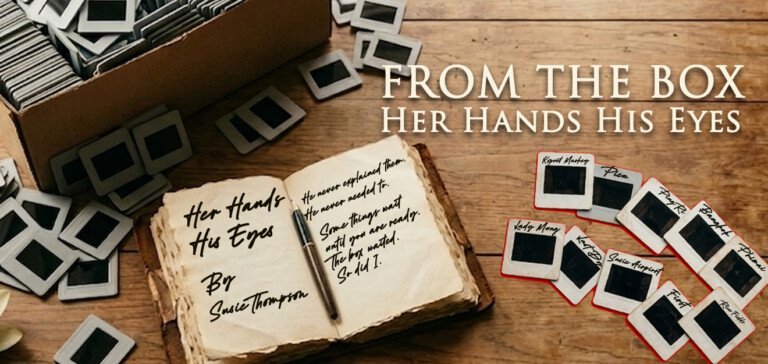
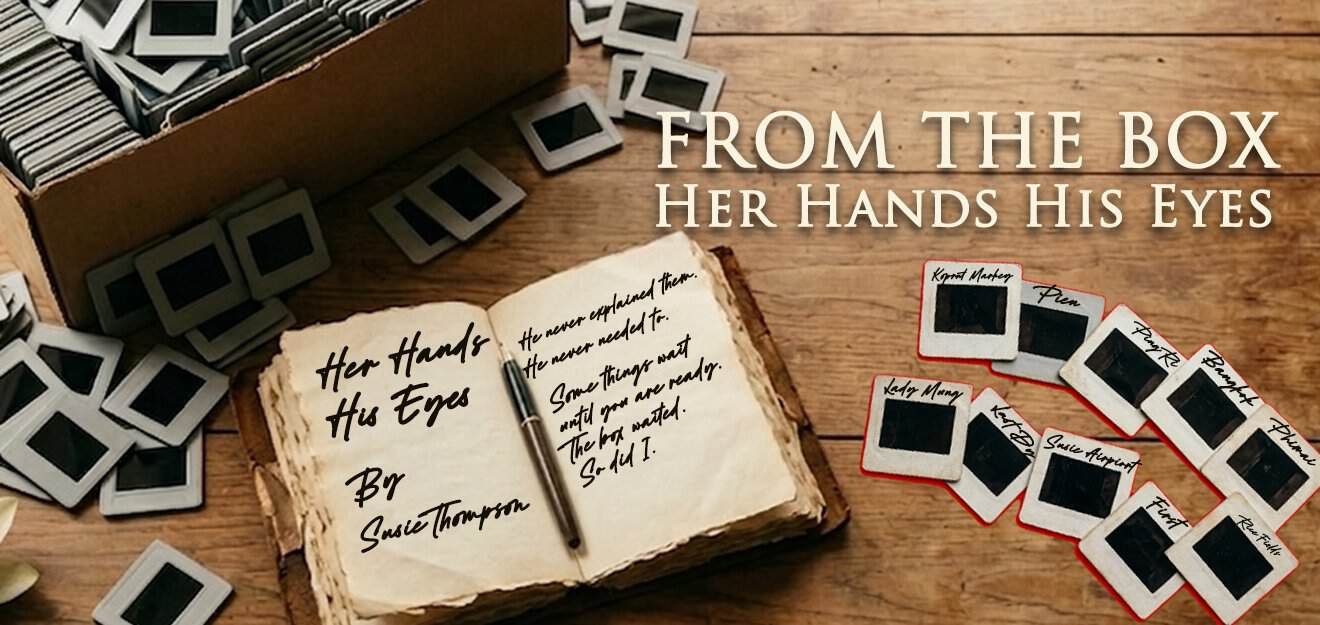
Her Hands His Eyes is a journal written in real time about writing my book. Every week I open the box a little further. A memory. A photograph. A recipe. This is Entry 3. Start from the beginning with Entry 1. You are reading this as I write it. When the book is ready you will be the first to know. Open The Box.
I have been sitting at my desk all week trying to write this chapter.
I thought I knew how to do it. I lived it. I was there. I held the slides in my own hands and put them in the scanner myself and watched the images appear on the screen one by one.
I thought that would make it easier to write.
It doesn’t.
That is the thing nobody tells you about grief and memory. Living through something and writing about it are two completely different kinds of hard.
What I Am Writing About This Week
I am writing about the morning I walked into my kitchen and found a slide scanner on the counter.
Chris had put it there without saying a word.
I stood there and felt the anxiety wash over me immediately. Not fear exactly. Something closer to standing at the edge of something very deep knowing you are about to go in. Not knowing what was coming up from that box. Not knowing if I was ready for it. Not knowing if I would ever be ready for it.
Twenty-four years of not being ready.
And now a slide scanner on the counter.
I stood there for a long time. Just me and the box in the closet and the scanner in the light and the anxiety of someone who knows that opening something changes everything. That you cannot un-see what you see. That whatever was in that box was about to become real in a way it had never been real before.
And then Chris walked in.
He took one look at me.
Forty years together. No words needed. He crossed the kitchen and put his arms around me and in that moment everything shifted. The anxiety did not disappear. But it made room for something else. A calm. A sense that whatever was in that box we were going to face it together. That I did not have to be ready alone.
He said it’s time.
And just like that I was ready.
That is forty years of knowing someone. No explanation. No ceremony. Just a hug and two words and a room full of calm where the anxiety had been.
Every time I try to write that sentence I have to stop.
Not because I don’t know what comes next. Because I know exactly what comes next and it hits me the same way every single time. Like it is still happening. Like I am still standing in that kitchen with his arms around me and the box in the closet and the scanner on the counter and my whole life about to shift in a way I cannot yet see coming.
That is what writing this book is doing to me.
It is keeping me inside the moment while I try to find words for it.
“Some things you carry for so long you forget they have weight. The box remembered.”
The Roller Coaster
This week broke me open in ways I did not expect.
I sat at my desk and I tried to write and instead I thought about my father.
Not the father in the slides. The father I knew. I thought about Solomons Island. The two of us sitting on the pier together. The water and the light and the particular way he had of sitting beside you without needing to fill the silence. He was good at that. Being present without making a production of it. Just there. Solid. Certain.
I thought about my children.
They never really got to know him. That landed on me this week in a way it hasn’t in a long time. He was their grandfather and they were so young and now he is gone and all they have are the stories I tell them and the photographs in that box. That is not nothing. But it is not the pier at Solomons Island either. It is not his particular silence. It is not the way he showed up.
I cried about that.
I thought about my mother and our trip back to Thailand. Walking those streets with her. Watching her move through a country she had never stopped belonging to even after fifty years of living somewhere else. The way Thailand fit her differently than America did. The way she exhaled there in a way I never noticed her exhaling here.
I thought about my grandmother. Kun Yai on the wooden floor in Kamphaeng Phet. Her hands. The way she moved in that kitchen. The way she and my mother were the same person in different generations doing the same things without ever talking about doing them.
I thought about my American grandfather. The man who made room for a little girl from Korat the moment she arrived. Who never made her feel like a stranger. Who just opened the door and said come in and meant it completely.
All of them with me at my desk this week.
All of them in that box.
I carried the weight of it all week. Some days I could write. Some days I closed the laptop and walked away and sat somewhere quiet and let the grief and memory do what they needed to do.
That is what this book is costing me.
That is also what it is giving me.
“My father believed life didn’t wait.”
What I Know Now
There is a particular kind of exhaustion that comes from writing about the people you have lost.
It is not the exhaustion of hard work. It is the exhaustion of feeling everything twice. Once when it happened. Once when you write it down.
I have felt everything twice this week.
And I would do it again.
Because the alternative is silence. And silence means they disappear. And I am not willing to let them disappear.
You are reading this as I write it. When the book is ready you will be the first to know. That is what The Box is for.
I am writing it all down.
For Remi, Samantha, Jackson.
So they know what we carried.
So they know who carried it.
So they know the man on the pier at Solomons Island. And the woman in the orange dress on the Ping River. And the grandmother on the wooden floor in Kamphaeng Phet. And the American grandfather who opened the door and never made anyone feel like a stranger.
So the box never has to wait twenty-four years for them.
What Comes Next
This is Entry 3 of Her Hands His Eyes — a memoir written in real time as I open the box.
In Entry 4 the moment I understood what this book really was. It did not happen the way I expected.