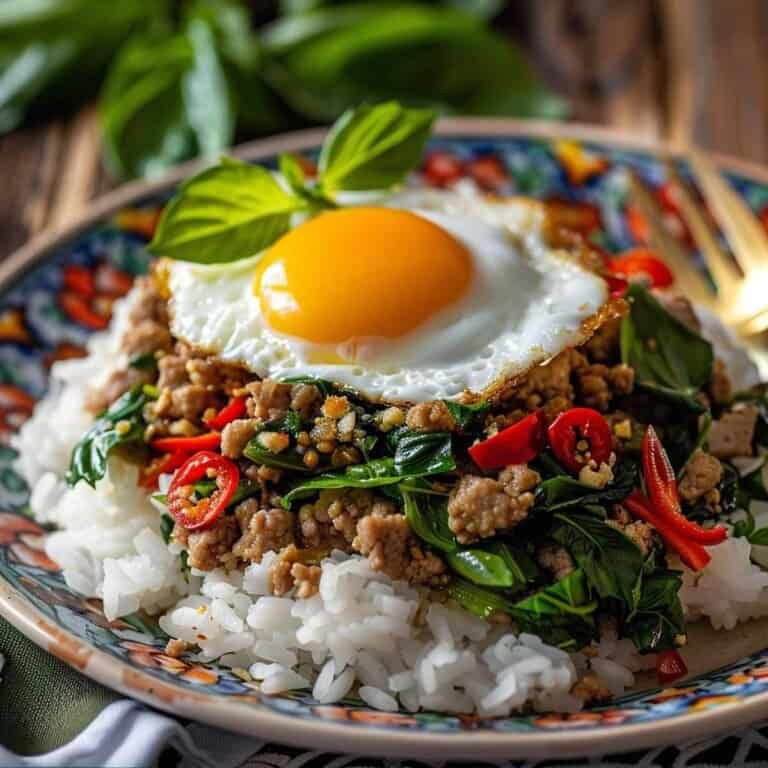
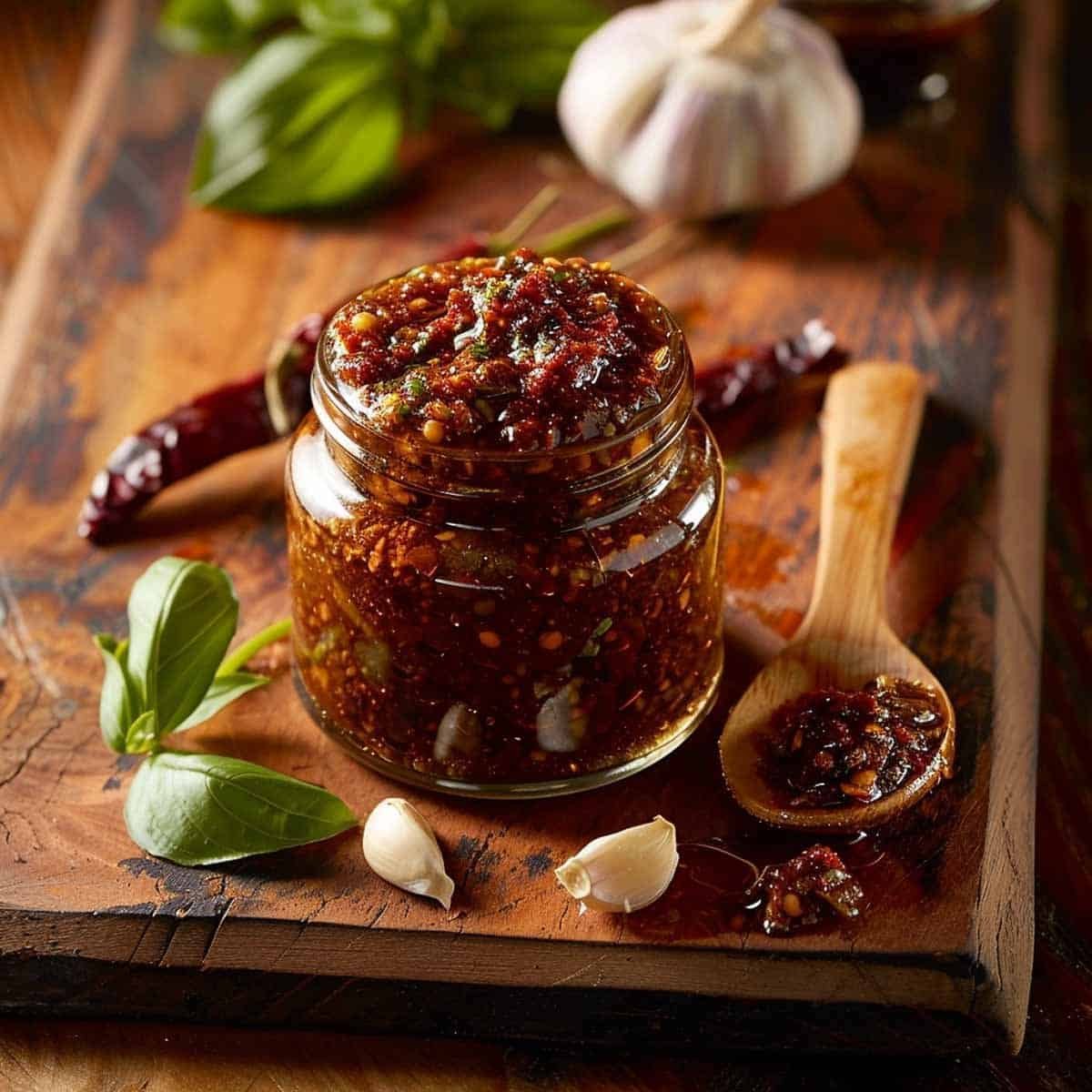
What Is Nam Prik Pao?
Nam Prik Pao (น้ำพริกเผา) is Thailand’s famous roasted chili paste made from dried chilies, garlic, shallots, shrimp paste, and tamarind. Sweet, smoky, spicy, and deeply savory, it is the key ingredient in Tom Yum soup and many traditional Thai dishes.
Note From Susie

Sawasdee Kha, and Hello.
The chilies hit first.
That is how I remember it, the smell arriving before anything else had registered. My mother and her sisters made Nam Prik Pao outside most of the time. The open air, the fire or the dry pan, the chilies going in and the smell rising immediately and finding you wherever you were. You did not have to be looking. The smell told you what was happening.
Sometimes it was made inside, in one of the family kitchens. But outside is how I remember it most. One person working. The others nearby. The chilies first, then the garlic and shallots picking up the heat, then the shrimp paste coming in underneath everything and pulling it all into something deeper and more complex than any single ingredient could have been alone.
They made it whenever they wanted to add heat, to a soup, to rice, to whatever the day had already put on the table. It was not a dish by itself. It was the thing that made other things more. The finished paste was always smooth. That smoothness was the goal and they always reached it.
I still smell the chilies first when I make this. My own pan, my own mortar. The same smell finding me the same way.

What’s In This Page
“I still smell the chilies first when I make this.”
— Her Hands His EyesWhat Is Nam Prik Pao?
Nam Prik Pao, น้ำพริกเผา, sometimes called Thai roasted chili paste or Thai chili jam, is one of the most foundational condiments in Thai cooking. The name translates roughly as roasted chili water, though paste is the more accurate description of what it becomes. Dried red chilies, garlic, and shallots are dry-roasted or charred until deeply colored and fragrant, then ground together with shrimp paste, palm sugar, fish sauce, and tamarind into a smooth, dark, intensely flavored paste.
What makes Nam Prik Pao distinct from other Thai chili pastes is the roasting. The ingredients are not used raw. They are taken to a place of heat first, where their sugars caramelize and their edges char and something smoky and complex develops before they ever reach the mortar. The result is a paste that carries both heat and depth in equal measure: the dried chili’s sharpness, the roasted garlic’s sweetness, the tamarind’s sourness, the shrimp paste’s fermented underpinning, all of it ground together until smooth.
Nam Prik Pao is used as a base for Tom Yum soup, stirred into stir-fries, spread on rice, used as a dipping sauce, or eaten as a condiment alongside nearly anything. According to the Oxford Companion to Food, chili pastes and relishes are among the oldest and most central elements of Thai cuisine, with roasted versions found across every region of the country.
The chilies hit first. That has always been true.
WHAT YOU’LL NEED
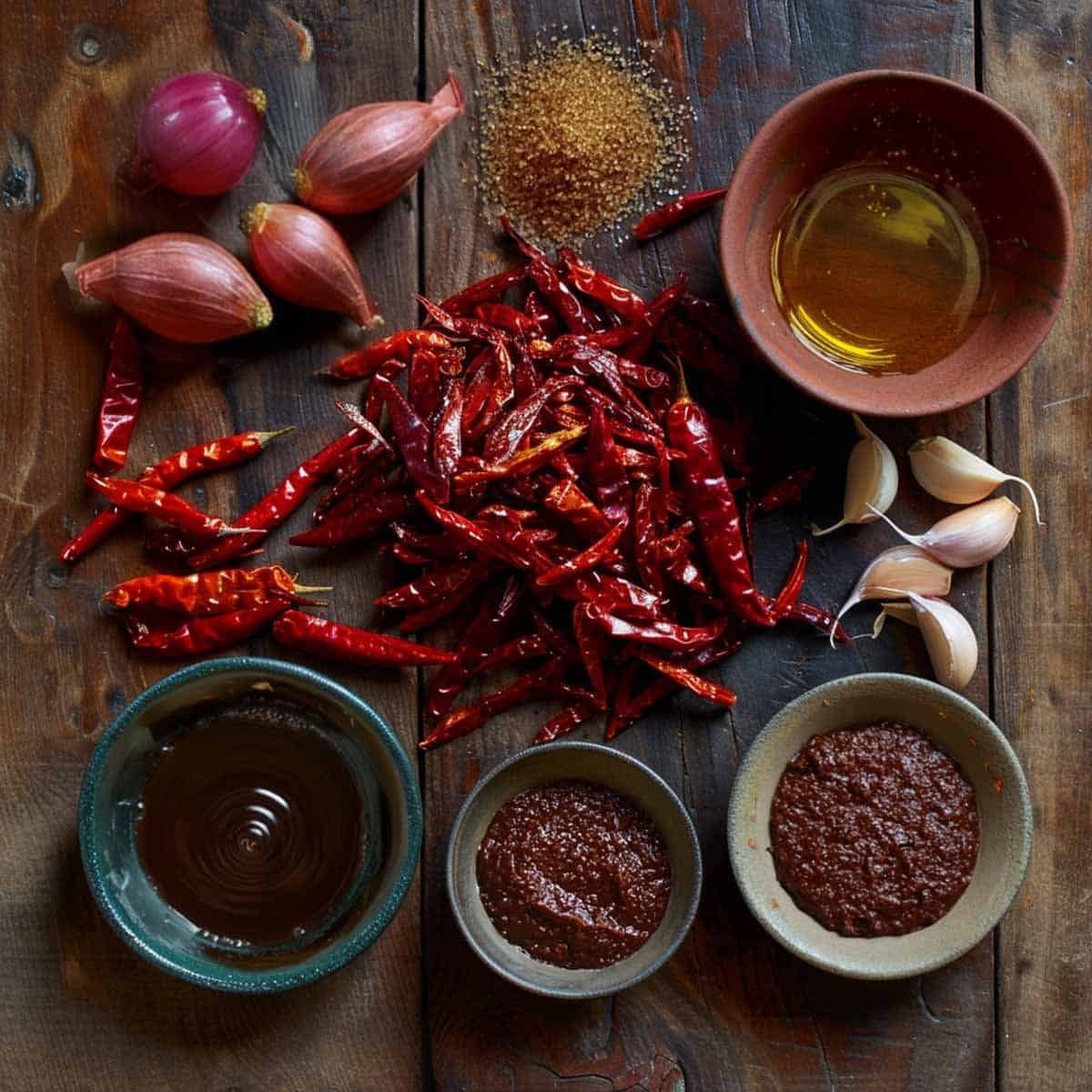
Dried red chilies, one cup, deseeded and soaked. Large dried chilies give you color and moderate heat. Smaller dried Thai chilies bring sharper, more immediate heat. A combination of both is traditional. Remove the seeds from the large ones for less fire. The soaked, drained chilies are what goes into the mortar or food processor.
Shallots, half a cup, chopped. Garlic, a quarter cup, minced. These are roasted in the pan until golden brown and fragrant before going into the paste. The roasting transforms their sharpness into something sweeter and more complex.
Shrimp paste, 1 teaspoon. It goes into the food processor or mortar with the roasted chilies, shallots, and garlic. The roasting mellows its sharpness while keeping its fermented depth.
Palm sugar, half a cup grated, for the sweetness that balances the heat and sourness. Tamarind paste, a quarter cup, for the sourness that holds everything in balance. Fish sauce, a quarter cup, for the salt and savory depth.
Vegetable oil, half a cup, for cooking the paste and giving it its glossy, slightly loose texture.
VISUAL WALK THROUGH
Step 1. Prepare the chilies.
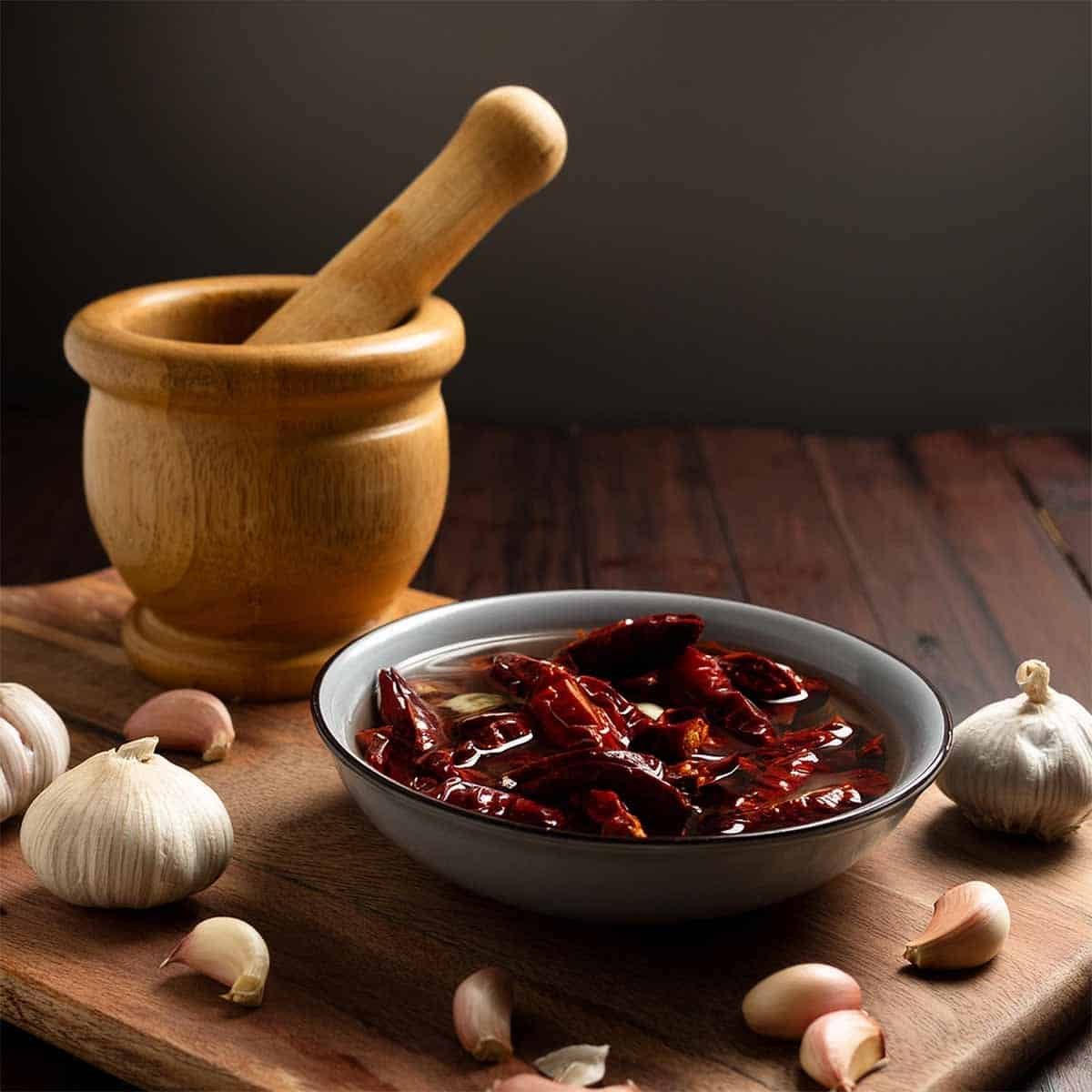
Begin by draining the soaked red chilies thoroughly. Heat a heavy bottomed pan over medium heat and dry roast the chilies until they become fragrant, stirring frequently to prevent burning. Remove from heat and set aside to cool. The chilies should be deeply fragrant and slightly charred at the edges. This is where the smokiness of Nam Prik Pao is built. Do not rush this step.
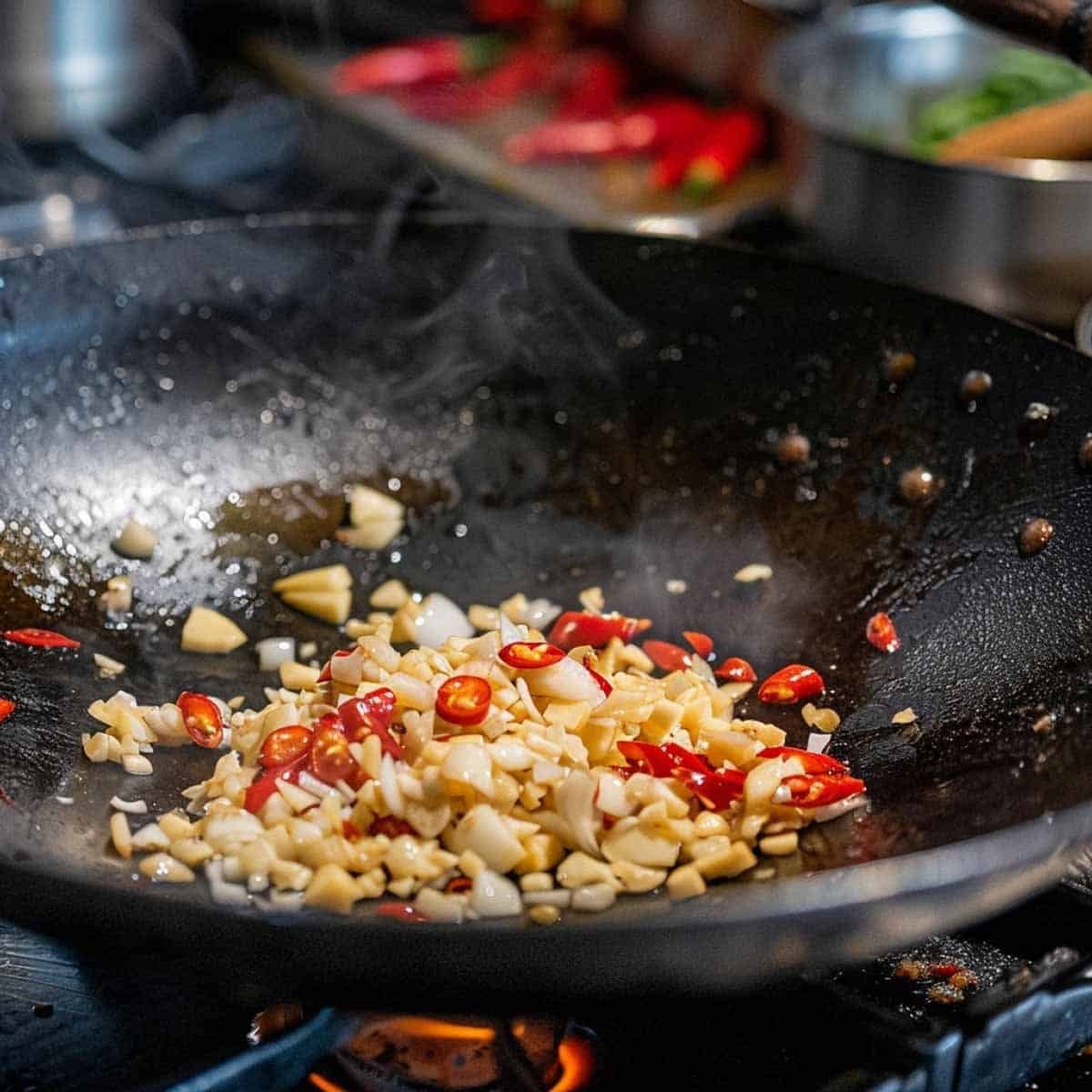
Step 2. Roast the shallots and garlic until golden.
In the same pan used for the chilies, dry roast the chopped shallots and minced garlic until they turn golden brown. This step enhances their natural sweetness and depth of flavor. Remove from the pan and set aside. The golden color and the fragrance are the signals that they are ready.
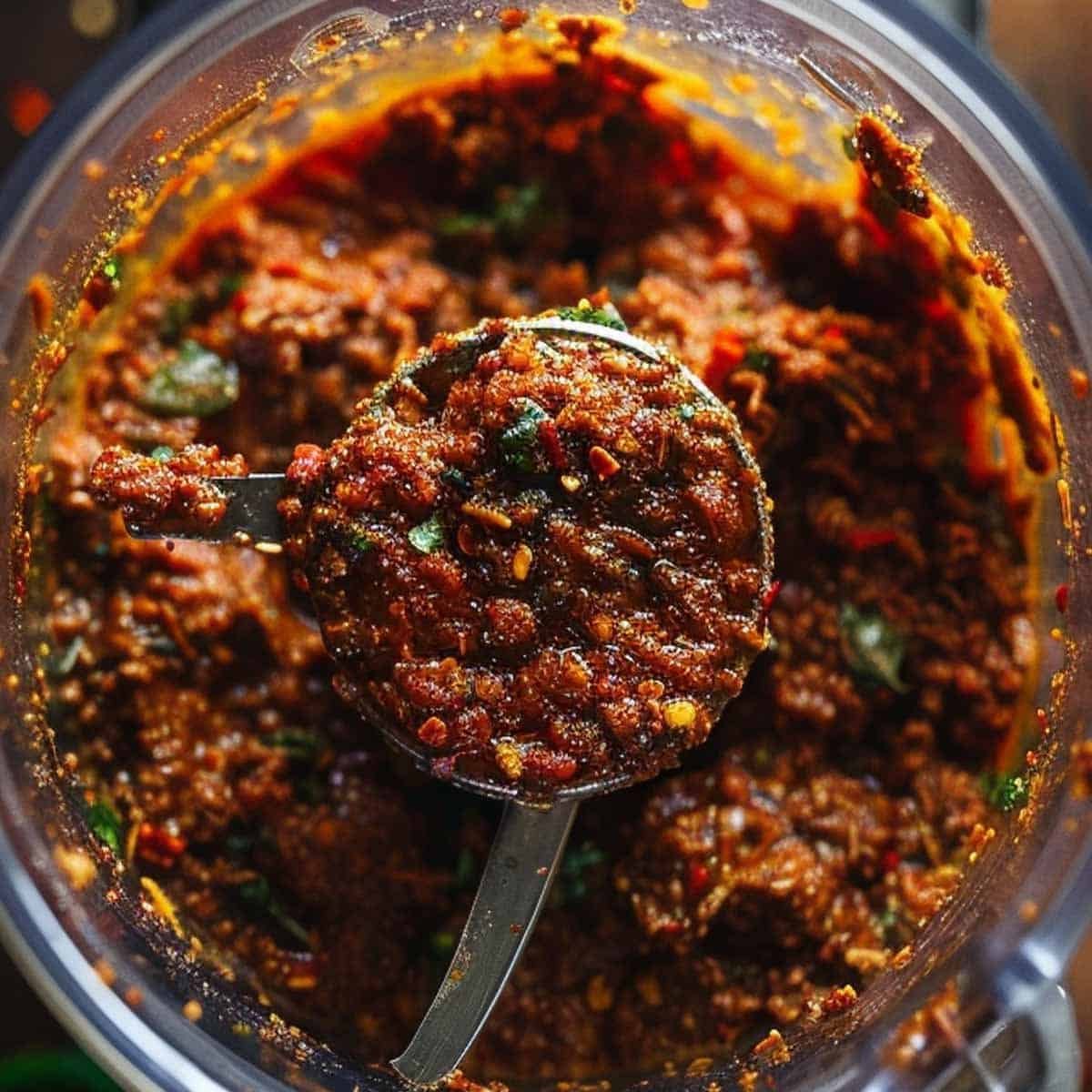
★ Step 3. Blend into a smooth paste.
Transfer the cooled roasted chilies, shallots, and garlic into a food processor or blender. Add the shrimp paste. Blend on high until a smooth paste forms, scraping down the sides as needed to ensure even blending. The paste should be deeply colored, uniform in texture, and fragrant. This step requires patience. Scrape the sides and blend again until no visible pieces remain.
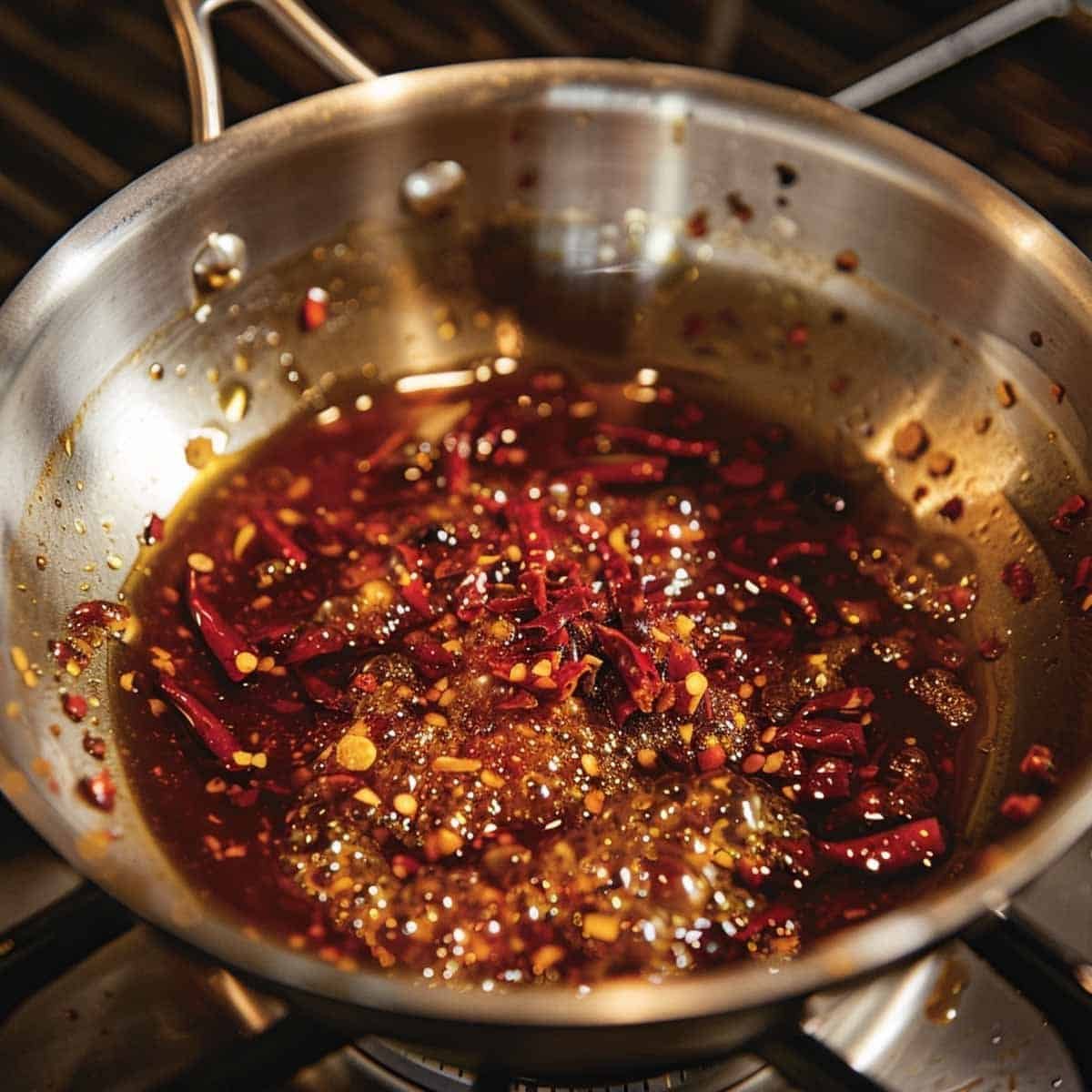
Step 4. Cook the paste in oil and add the seasonings.
Heat vegetable oil in a clean pan over medium heat. Add the blended chili paste and fry until aromatic, stirring constantly to prevent burning. Once the paste is fragrant, stir in the grated palm sugar, tamarind paste, and fish sauce. Allow the mixture to simmer gently, stirring occasionally, until it thickens to a paste-like consistency. Taste. It should be smoky, sweet, sour, and salty in balance. Adjust seasoning to taste.
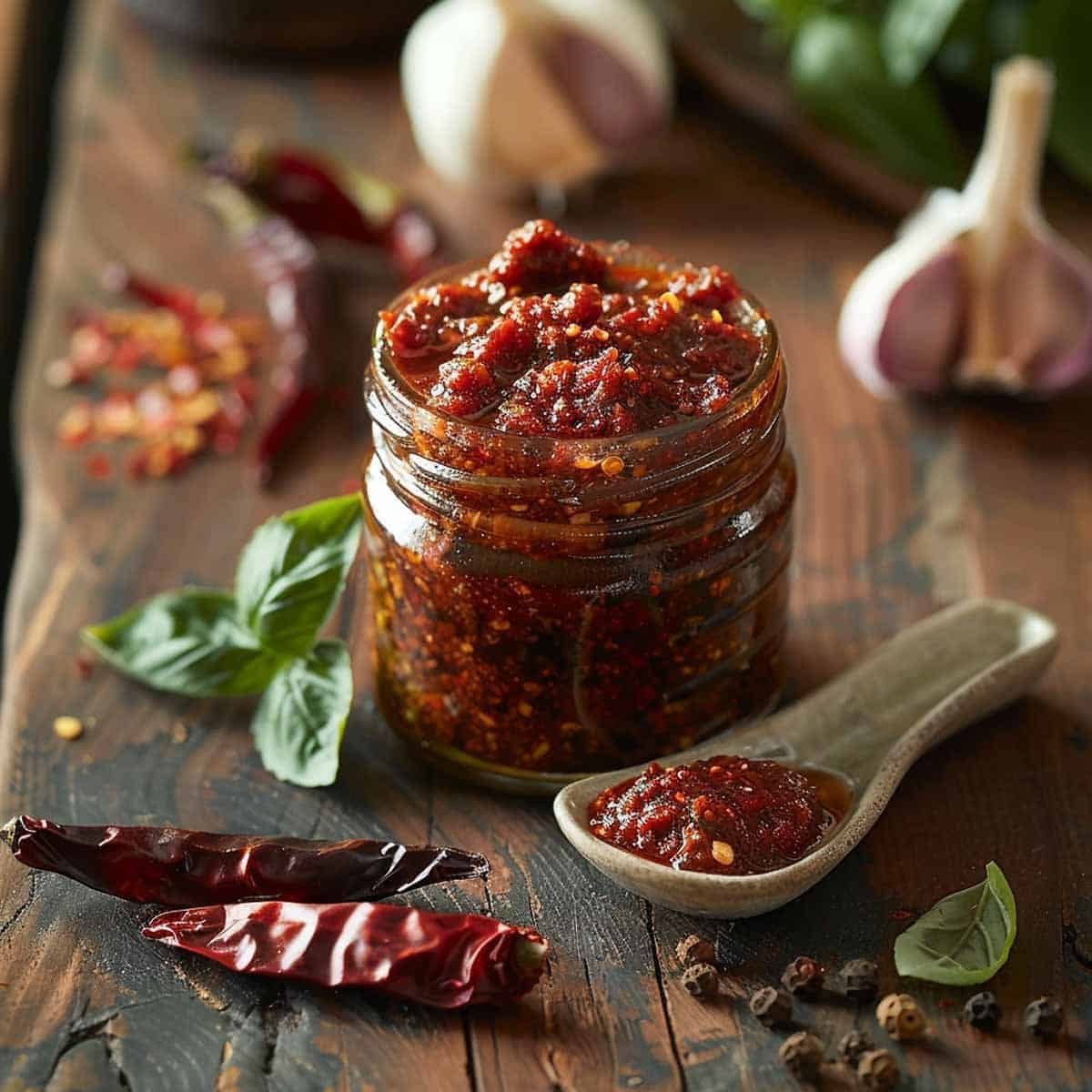
Step 5. Cool and store.
Remove the pan from heat and let the Nam Prik Pao cool to room temperature. Transfer into sterilized jars or airtight containers, ensuring they are tightly sealed. Refrigerate the paste to maintain its freshness and flavors for up to two weeks. The smell when you open the jar is the same smell that found you when the chilies first hit the pan.

Nam Prik Pao (Thai roasted chili paste)
Ingredients
- 1 cup dried red chilies deseeded and soaked
- 1/2 cup shallots chopped
- 1/4 cup garlic minced
- 1 tsp. shrimp paste
- 1/4 cup palm sugar grated
- 1/4 cup tamarind paste
- 2 tbsp. fish sauce
- 1/2 cup vegetable oil
Instructions
- Prepare the Chilies:Begin by draining the soaked red chilies, ensuring they are thoroughly dried. Heat a heavy bottomed pan over medium heat and dry roast the chilies until they become fragrant, stirring frequently to prevent burning. Remove from heat and set aside to cool.
- Roast Shallots and Garlic:In the same pan used for the chilies, dry roast the chopped shallots and minced garlic until they turn golden brown.
- Combine Ingredients:Transfer the cooled roasted chilies, shallots, and garlic into a food processor or blender. Add shrimp paste to the mixture. Blend on high until a smooth paste forms, scraping down the sides as needed to ensure even blending.
- Cook the Paste:Heat vegetable oil in a clean pan over medium heat. Add the blended chili paste mixture and fry until it becomes aromatic, stirring constantly to prevent burning.
- Add Seasonings:Once the paste is fragrant, stir in grated palm sugar, tamarind paste, and fish sauce. Allow the mixture to simmer gently, stirring occasionally, until it thickens to a paste like consistency. Adjust seasoning to taste.
- Cool and Store:Remove the pan from heat and let the Nam Prik Pao paste cool to room temperature. Transfer it into sterilized jars or airtight containers, ensuring they are tightly sealed. Refrigerate the paste to maintain its freshness and flavors for up to 2 weeks.
Notes
Nutrition
LET’S GET THIS RIGHT
Why does my Nam Prik Pao taste flat and sharp instead of smoky and complex?
The chilies and aromatics were not roasted long enough. The roasting stage is where the depth of Nam Prik Pao is built, the caramelization of the garlic and shallots, the charring of the chili edges. If the roasting is underdone, the paste will taste of raw dried chili rather than something that has been transformed by heat. Go further than you think you need to. The char is the flavor.
Why is my Nam Prik Pao paste not smooth?
The chilies were not soaked long enough after roasting, or the blending was not completed before the next ingredient was added. Roasted dried chilies need fifteen to twenty minutes of soaking in warm water before they will blend smoothly. Add each ingredient only when the previous one is fully broken down. Threads of chili skin that are visible will still be visible in the finished paste.
Can I make Nam Prik Pao in a food processor or blender?
Yes. The recipe uses a food processor or blender for the blending stage. Add the roasted soaking liquid a tablespoon at a time to help the machine move if the paste is too dry. Process in long bursts, stopping to scrape the sides. The texture will be smooth if the chilies have been properly soaked and roasted.
What does Nam Prik Pao taste like?
Nam Prik Pao is smoky, sweet, sour, salty, and hot, in that order and in balance. The smokiness comes from the roasted chilies and garlic. The sweetness from the palm sugar. The sourness from the tamarind. The salt from the fish sauce. No single flavor should dominate. If it tastes predominantly hot, it needs more palm sugar or tamarind. If it tastes predominantly sweet, it needs more fish sauce.
How do I use Nam Prik Pao?
Nam Prik Pao is one of the most versatile pastes in Thai cooking. It is the base flavor of Tom Yum soup. It is stirred into stir-fries for depth and heat. It is spread on rice as a condiment, used as a dipping sauce for grilled meat or vegetables, and added to noodle dishes. A jar of it in the refrigerator changes what any weeknight dinner can become with a single spoonful.
FLAVOR PROFILE
The chilies hit first. That is the order, always has been. Before the garlic, before the shrimp paste, before the tamarind pulls everything into its orbit. The dried chili smell is immediate and specific: smoky, slightly sweet from the heat of the pan, with a sharpness underneath that tells you exactly what is coming.
Then the garlic follows, roasted past its sharpness into something sweeter and more complex. Then the shallots, similar in their transformation. And then the shrimp paste, which does not arrive loudly but is present underneath everything, a fermented depth that holds the whole paste together without announcing itself.
In the pan, when it cooks in the oil, something changes again. The edges caramelize slightly, the tamarind sharpens and then rounds, the palm sugar pulls everything toward sweet-and-savory in a way that the raw paste alone could not achieve.
On the tongue: smoky first. Then sweet. Then the sourness of the tamarind arriving. Then the salt. Then the heat building from behind, slowly, the way dried chili heat always comes, not all at once, but building, staying, making itself known long after the first bite.
It is a paste that makes other things more. That is what it was always for.
SUSIE’S KITCHEN NOTES
My mother and her sisters roasted the chilies outside for a reason. The smell of dried chilies charring in a hot pan is intense, not unpleasant, but immediate and pervasive. It fills whatever space it is made in and it stays. If you are making Nam Prik Pao inside, open windows and run the ventilation. The smell will find every room. This is not a warning. It is information. The smell is part of what this paste is.
The type of dried chili matters more than it does in most recipes because the chili is the whole foundation. Large dried chilies contribute body, color, and moderate heat. Small dried Thai bird chilies contribute sharp, immediate heat and less color. A blend of both is traditional and correct. If you can only find one type, use large dried chilies for a milder result or small ones for a hotter one.
The oil that goes into the cooking stage of Nam Prik Pao is part of the paste’s structure. It is what gives the finished product its glossy, slightly loose texture that allows it to be stirred into soups and sauces without clumping. Do not reduce the oil. The oil is doing work. Use the full amount.
Tamarind from a block, soaked in warm water and pushed through a strainer, is more complex in flavor than tamarind concentrate from a jar. Both work. The block version requires more preparation but produces a paste with more depth and a truer sourness. If you are using concentrate, start with less and taste before adding more. Concentrate is more intense and the balance tips quickly.
PAIRING SUGGESTIONS
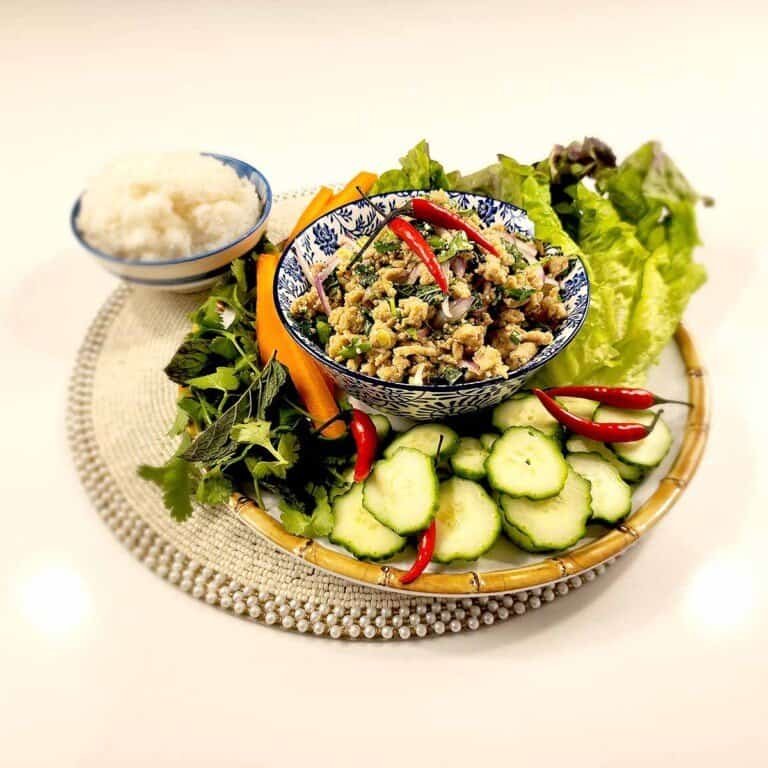
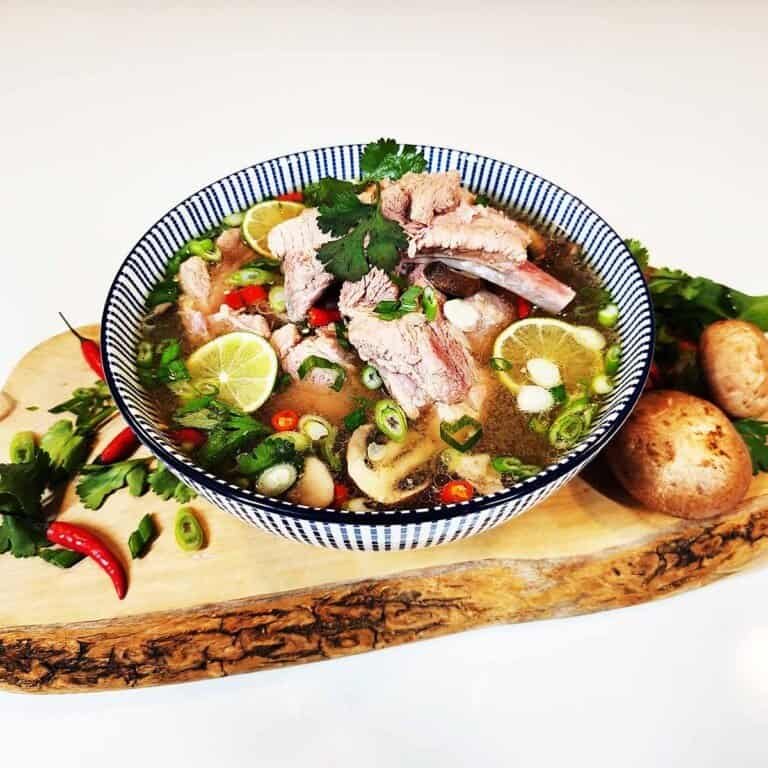
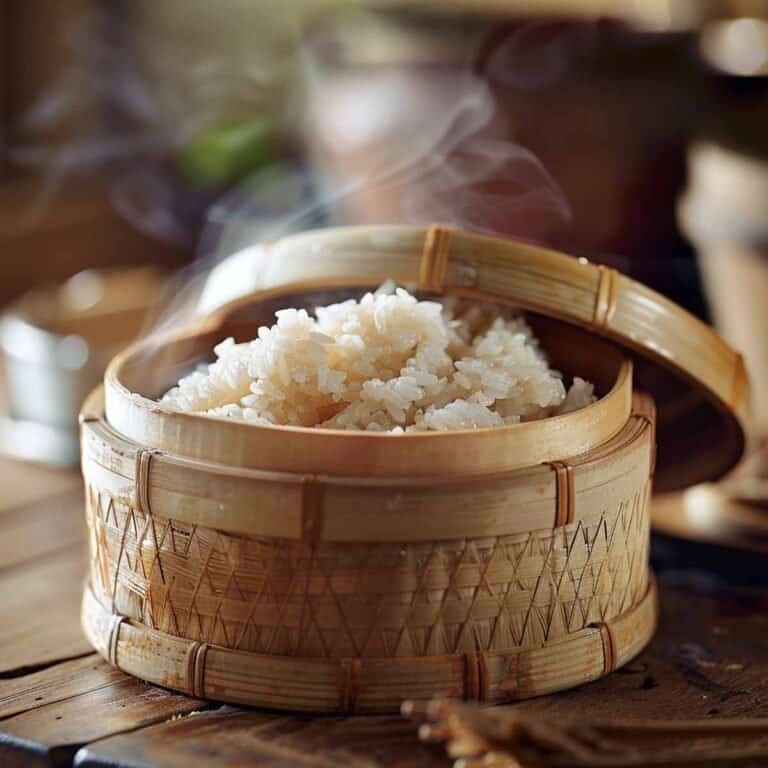
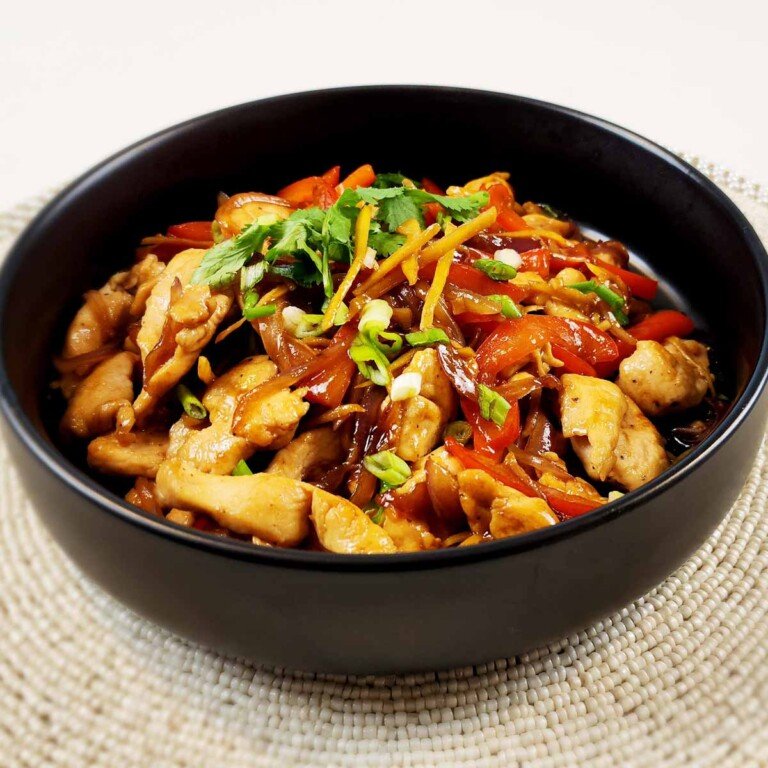
Nam Prik Pao is not a standalone dish. It is the thing that goes into other things and makes them more. Its most famous application is Tom Yum soup, where a spoonful stirred into the hot broth at the start gives Tom Yum its characteristic deep, smoky heat beneath the brightness of the lime. For a table where the paste meets rice directly, a spoonful alongside steamed jasmine rice and the Thai omelet is one of the simplest and most satisfying combinations in Thai home cooking. The paste also transforms stir-fries, a teaspoon stirred into the wok with the Thai cashew chicken deepens the sauce in a way that no amount of additional oyster sauce can replicate. For the chicken larb, a small amount of Nam Prik Pao stirred into the dressing adds a smoky layer beneath the lime and fish sauce. And for the drink alongside anything made with this paste, the Thai iced tea is cold and sweet and always the right answer. My mother made this to have it. That was always the reason. Make a full batch and keep it in the refrigerator. It will change what you can do with a Tuesday.
FAQ
What is Nam Prik Pao?
Nam Prik Pao, น้ำพริกเผา, is a Thai roasted chili paste made from dried red chilies, garlic, shallots, and shrimp paste that are roasted or charred before being ground smooth with tamarind, palm sugar, fish sauce, and oil. It is used as a base for Tom Yum soup, stirred into stir-fries, spread on rice, and used as a condiment throughout Thai cooking. It carries smoky, sweet, sour, salty, and hot flavors in balance. The finished paste is always smooth.
How do you make Nam Prik Pao from scratch?
Drain soaked dried red chilies and dry-roast in a hot pan until fragrant. Dry-roast chopped shallots and minced garlic in the same pan until golden brown. Transfer the cooled roasted chilies, shallots, garlic, and shrimp paste into a food processor and blend until smooth. Heat vegetable oil in a clean pan, add the blended paste and fry until aromatic, then stir in palm sugar, tamarind paste, and fish sauce. Simmer until thickened and glossy. Cool before storing in an airtight jar in the refrigerator.
What is Nam Prik Pao used for?
Nam Prik Pao is one of the most versatile pastes in Thai cooking. It is the foundation flavor of Tom Yum soup. It is stirred into stir-fries for smoky depth. It is spread on rice as a condiment, used as a dipping sauce for grilled meats and vegetables, and added to noodle dishes. A jar of it in the refrigerator changes what any weeknight dinner can become with a single spoonful.
How long does homemade Nam Prik Pao keep?
Homemade Nam Prik Pao keeps in an airtight jar in the refrigerator for up to one month. The oil on the surface acts as a natural preservative. Do not remove it. Use a clean spoon each time you reach into the jar. It freezes well for up to three months. Making a full batch is practical. The work of making a large amount is the same as making a small one.
Is Nam Prik Pao the same as Thai chili paste in a jar from the store?
Store-bought Nam Prik Pao exists and is widely available at Asian grocery stores. Maesri and Pantai are common brands. It is a workable substitute when time does not allow for making it from scratch. Homemade Nam Prik Pao is significantly more complex and aromatic. The fresh roasting of the chilies and aromatics produces a depth that jarred paste cannot replicate. If you have the time, make it from scratch. If you do not, store-bought is better than omitting it entirely.
Can I make Nam Prik Pao without shrimp paste?
Yes. Omit the shrimp paste for a vegetarian version. The paste will be less complex in its fermented depth but will still produce a flavorful result. Some cooks substitute a small amount of white miso paste, half a teaspoon, for a similar fermented quality without the seafood. The finished paste will taste different but will still carry the smokiness, sweetness, sourness, and heat that define Nam Prik Pao.
How spicy is Nam Prik Pao?
Nam Prik Pao has a building heat rather than an immediate sharp heat. The dried chilies release their warmth slowly, and the palm sugar and tamarind moderate it. The heat level depends on the type and amount of dried chilies used. Large mild dried chilies produce a moderate paste. Small Thai bird chilies produce something significantly hotter. Remove seeds from the large chilies before roasting to reduce heat. Leave the small ones whole for full effect.