The One My Mother Started Simple
What Is a Thai Omelet (Kai Jiao)?
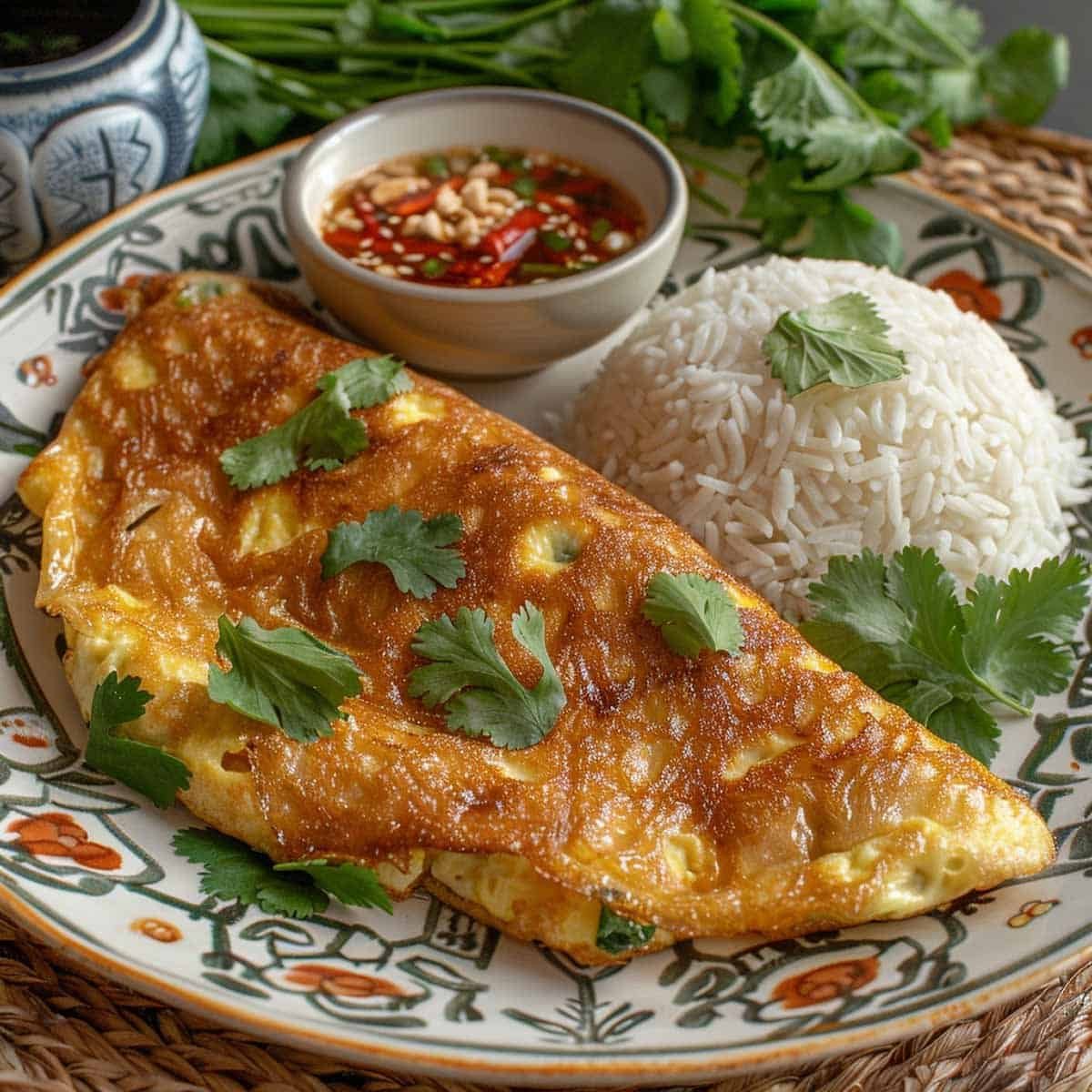
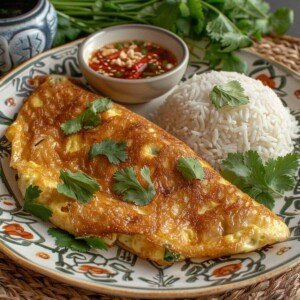
A Thai omelet recipe, Kai Jiao, is eggs beaten with fish sauce and fried in very hot oil until the edges blister and puff gold. It is not a French omelet. It does not fold softly. It arrives crisp at the edges, yielding in the center, and it goes over rice.
Note From Susie

Sawasdee Kha, and Hello.
When I was small, my mother Pien made this with almost nothing. Eggs. A splash of fish sauce. The wok already hot before she ever cracked the first one. That was it. Two ingredients, maybe three, and the result was something I would eat before I had finished sitting down.
She never explained it. It was not a lesson. It was just what appeared on the table.
As I got older, things were added. Ground pork. A handful of green onion. Sometimes tomato, soft and collapsing at the edges. She added without ceremony, the way she did everything, no announcement, no recipe card, just her hands knowing what the dish needed at that time in our lives.
I still make the simple version. Some mornings that is all I want. Eggs and fish sauce and very hot oil. The thing that started it.
But I know the fuller version now too. And I understand that both of them came from her hands.

What’s In This Page
“She did not know I was doing it. That is the thing I come back to most.”
— Her Hands His EyesWhat Is Thai Omelet (Kai Jiao)?
A Thai omelet, ไข่เจียว, Kai Jiao, is one of the most common dishes in Thailand, and one of the most misunderstood outside of it. The name translates simply as fried egg, but that translation does not prepare you for what arrives. This is not a folded French omelet. It is not scrambled eggs in disguise. The eggs are beaten with fish sauce, sometimes a touch of soy sauce, then poured into oil that is genuinely hot, and left alone to do what very hot oil does to a beaten egg: it puffs the edges into something crisp and golden, leaving the center just set.
It is eaten over rice. Almost always. In Thailand it is a dish for every meal, breakfast, lunch, a fast dinner. Street vendors make it in seconds. Home cooks keep it as the thing that appears when nothing else has been decided yet. According to the Oxford Companion to Food, egg-based dishes fried in oil have been a staple of Southeast Asian cooking for centuries, shaped by the availability of the wok and the high heat traditions that came with it.
The sound of the egg hitting the oil. That is the first thing. You hear it before you smell it.
What You’ll Need
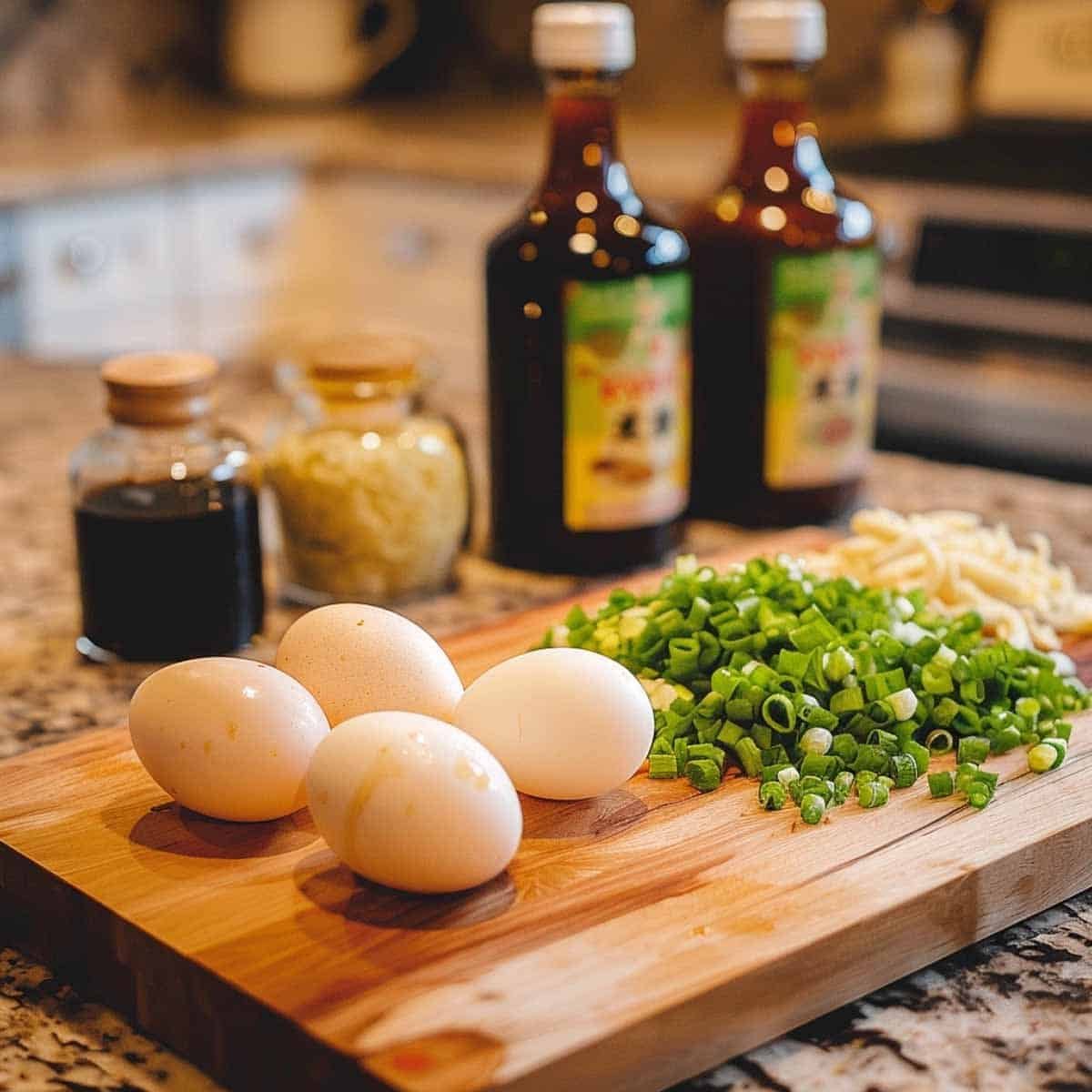
Eggs first. Two or three, depending on how large you want the omelet. Beat them completely. No streaks of white. No pockets of yolk sitting unmixed. Beat them until they are one thing.
Fish sauce is what makes a Thai omelet a Thai omelet. Not soy sauce, though soy sauce can be used for a slightly lighter, less briny result, and some cooks use both. Fish sauce carries salt and a depth that soy sauce does not quite reach. One tablespoon for two eggs is where to start. The eggs should taste seasoned before they hit the pan.
Oil. More than you think. This is where many people go wrong. Kai Jiao needs enough oil to allow the egg to puff and blister. A thin coat of oil in a nonstick pan will give you something soft and flat. That is not this dish. A neutral oil, vegetable or canola, filled to a depth that lets the egg float slightly at the edges. A quarter cup in a medium wok is not too much.
The simple version ends there. Eggs, fish sauce, oil.
For the fuller version: ground pork, stirred directly into the beaten egg before frying. A handful of green onion, sliced thin. A small tomato, seeded and roughly chopped. White pepper. These additions go in before the egg hits the pan, mixed together, not added after. The whole thing goes in as one.
A bit of sriracha on the side if you want heat. Steamed jasmine rice underneath, always. My mother never measured the fish sauce. It should taste slightly too salty on its own. The rice corrects it.
VISUAL WALK THROUGH
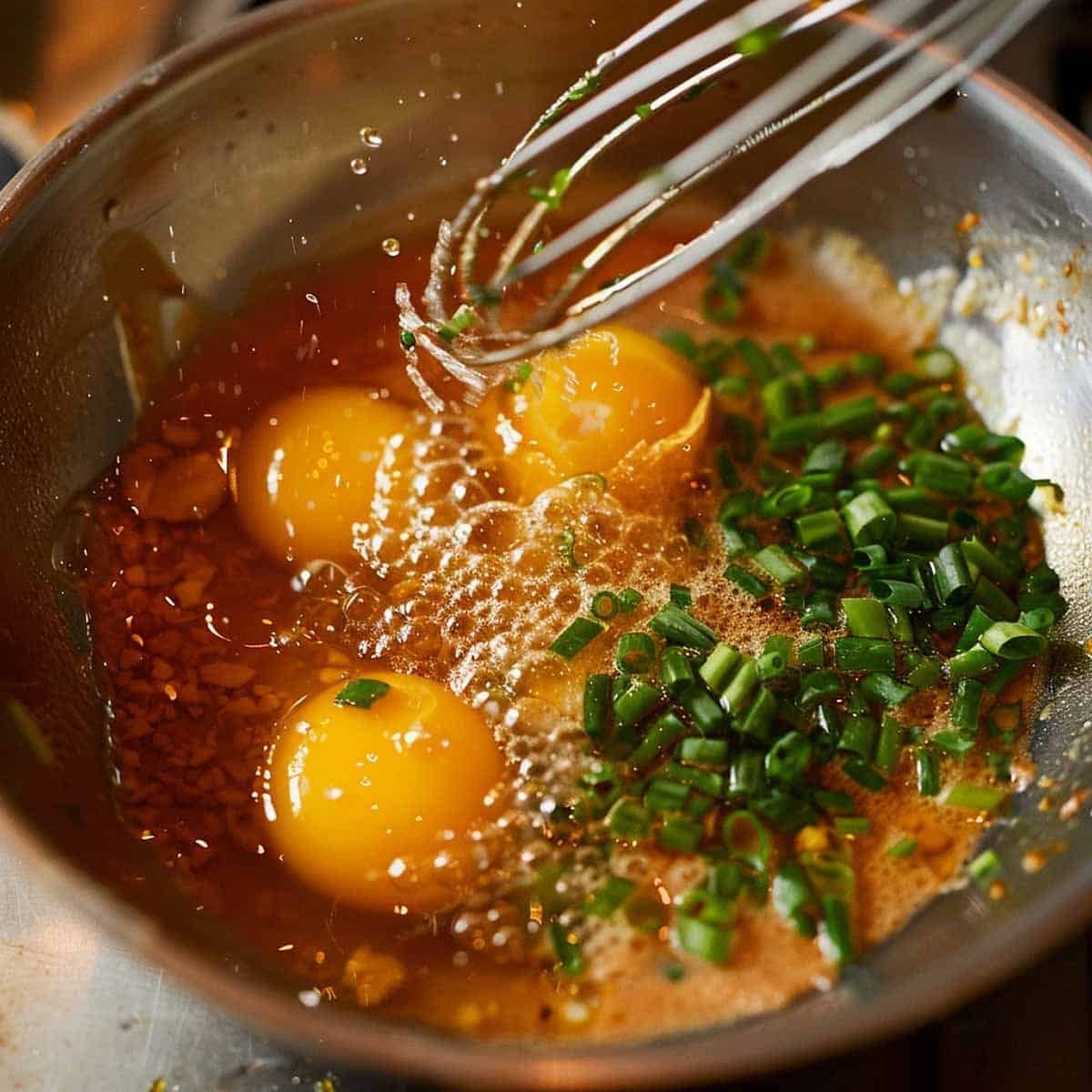
Step 1. Beat the eggs completely.
Crack the eggs into a bowl. Add the fish sauce. Beat until there are no streaks, not thirty seconds of half-hearted stirring. A full minute. The mixture should be uniform in color and slightly foamy at the surface. If you are adding pork, green onion, or tomato, they go in now. One mixture. Everything together.
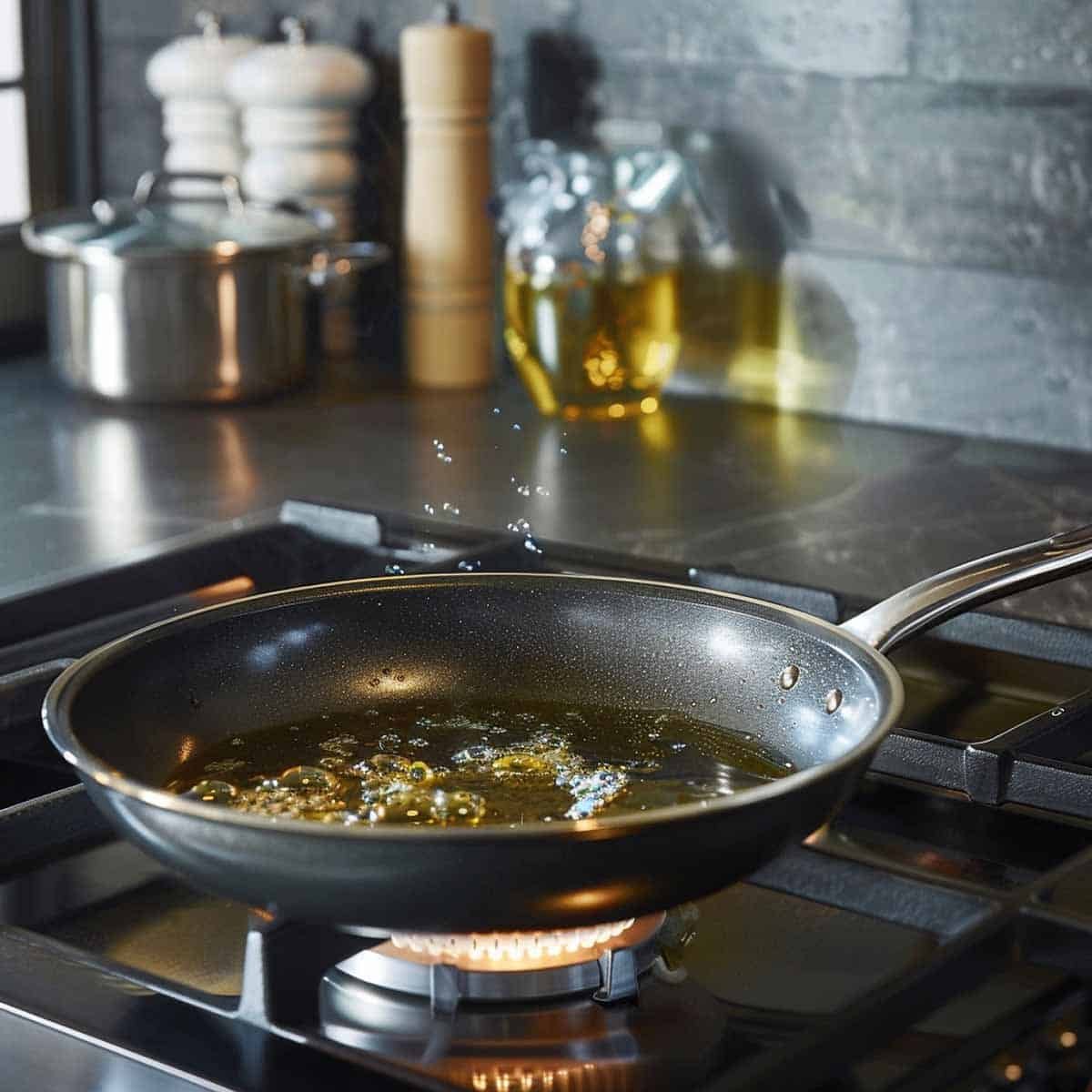
Step 2. Get the wok very hot. This is not optional.
Set the wok over high heat. Add the oil. Wait. The oil needs to be hot enough that a single drop of the egg mixture sizzles and sets immediately on contact. If the drop sinks and sits there, the oil is not ready. Keep waiting. This step is where the dish is made or lost. Cold oil gives you flat eggs. Hot oil gives you Kai Jiao.
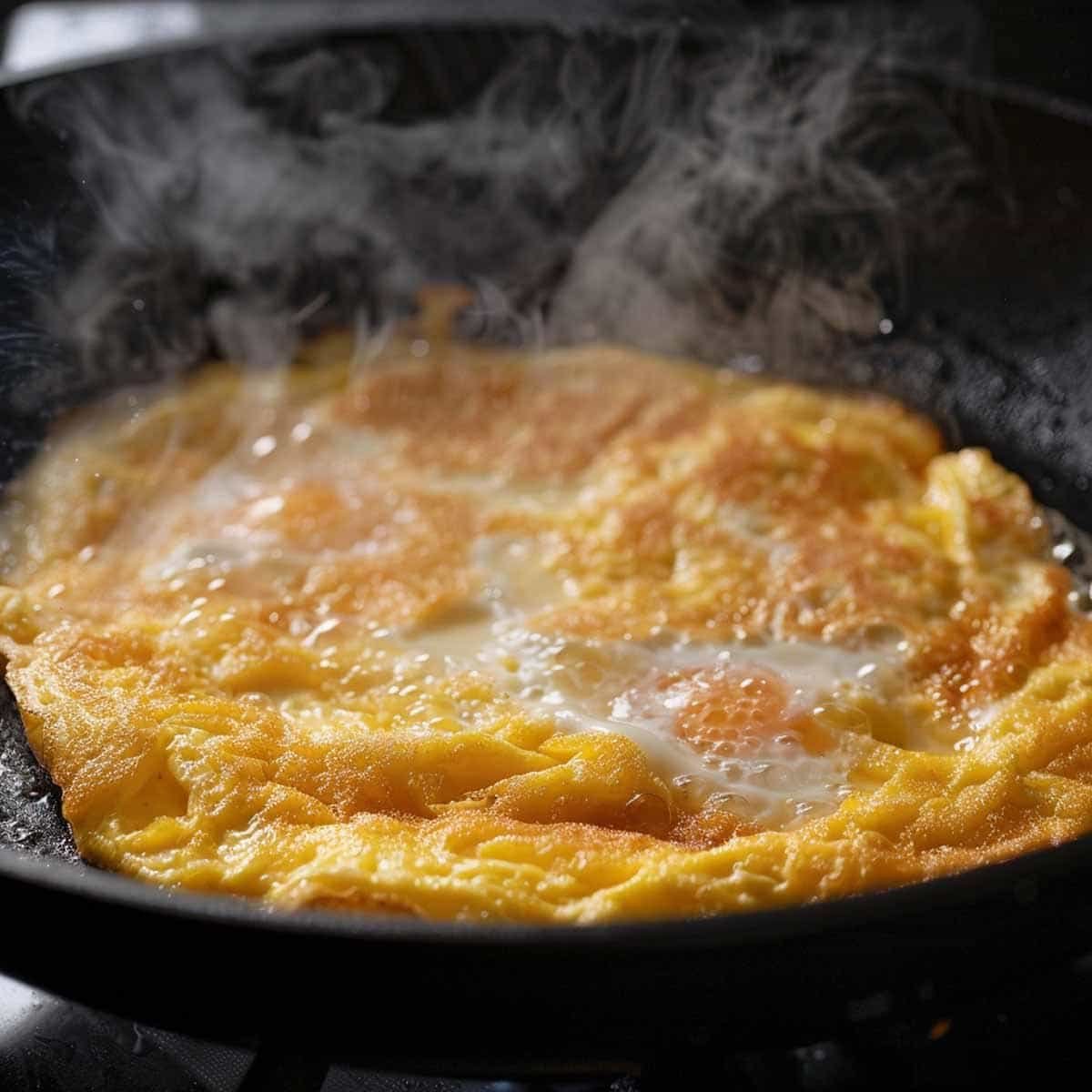
★ Step 3. Pour the egg in all at once and leave it alone. This is What Makes the Difference.
Pour the egg mixture into the center of the wok in one motion. Do not stir. Do not push. The hot oil will immediately begin working on the edges, they will puff and turn golden within seconds. This is what most recipes skip: the moment of stillness. Let the egg do what it does. Thirty seconds of leaving it completely alone is what creates the texture that makes Kai Jiao different from every other fried egg.
Step 4. Fold and finish.
When the edges are set and gold and the center is nearly done, still just slightly soft on top, fold the omelet in half or fold it into thirds. A thin spatula works. Do not press it down. Thirty more seconds in the pan. The center will finish from the residual heat.
Step 5. Plate over rice. Immediately.
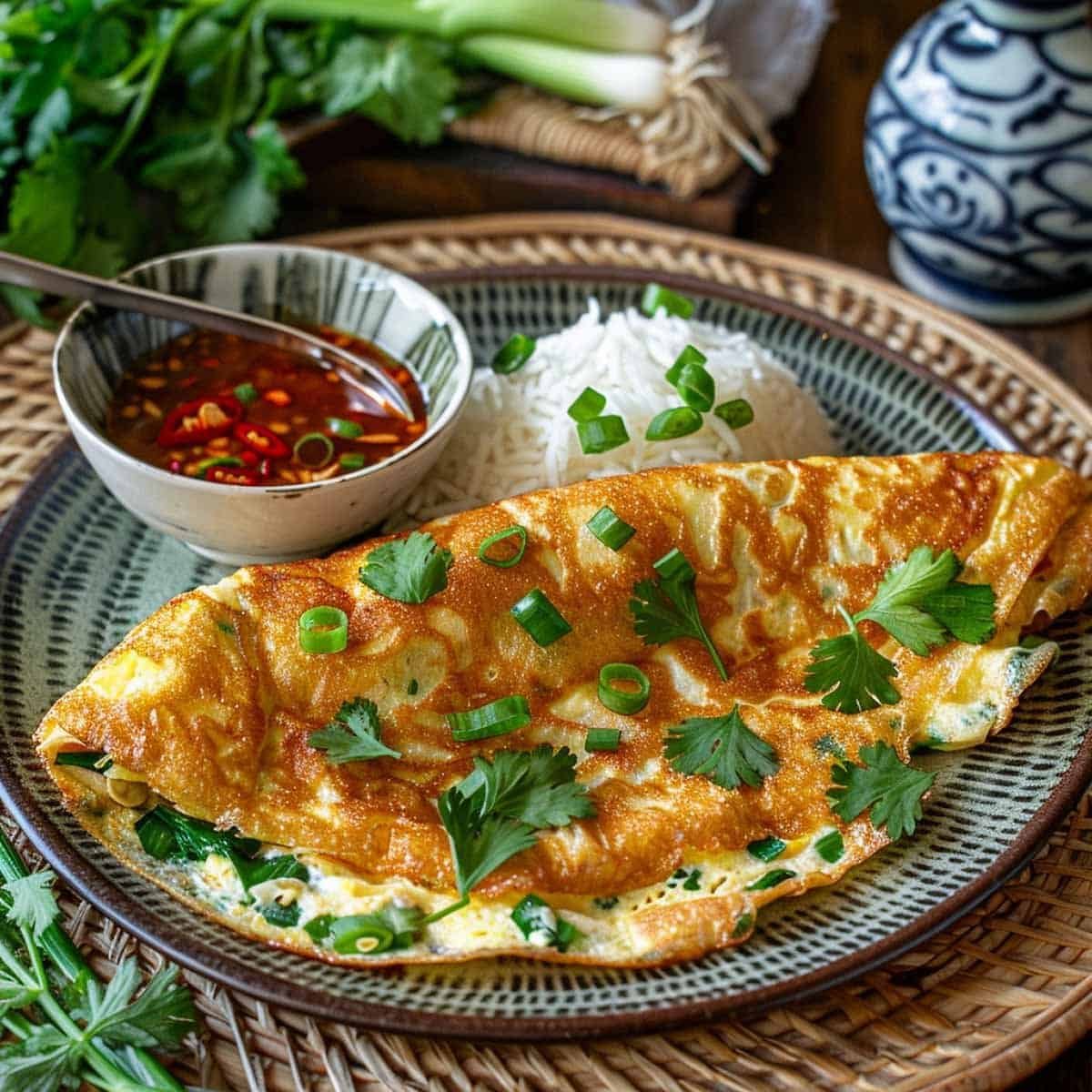
Slide the omelet directly onto steamed jasmine rice. It should arrive at the table hot. A line of sriracha along the fold if you want it. The rice softens the salt. The contrast between the crisp edge and the soft rice underneath, that is the whole point of this dish.
Easy Thai Omelet (Kai Jiao) Recipe
Ingredients
- 3 large eggs
- 1 tablespoon fish sauce
- 1 teaspoon soy sauce
- 1/4 teaspoon white pepper
- 2 green onions finely chopped
- 1/4 cup vegetable oil
- ground pork optional
Instructions
- Prepare the Ingredients:Crack the eggs into a bowl, then add the fish sauce, soy sauce, and white pepper. Whisk everything together until smooth and well combined.
- Heat the Oil:Pour the vegetable oil into a large frying pan or wok and heat it over medium-high heat until it is shimmering and hot.
- Cook the Omelet:Pour the egg mixture into the hot oil simultaneously. The mixture will puff up and create crispy edges. Let it cook undisturbed for 1-2 minutes until the bottom is golden brown. Carefully flip the omelet using a spatula and cook the other side for 1-2 minutes. The omelet should be crispy on the outside and soft on the inside.
- Serve:Slide the omelet directly onto steamed jasmine rice. It should arrive at the table hot. A line of sriracha along the fold if you want it. The rice softens the salt.
Notes
Nutrition
Let’s Get This Right
Why did my Thai omelet come out flat instead of puffy?
The oil was not hot enough, or there was not enough of it. Kai Jiao needs both heat and volume, the egg needs to make contact with oil that is actively sizzling, and there needs to be enough oil that the edges can puff and lift rather than cling to the pan and steam. Get the oil hot before the egg goes in. Do not rush this step.
Can I make a Thai omelet without a wok?
You can. A heavy skillet works, though a wok gives you better heat distribution and the curved sides help the egg form more naturally. In a skillet, use a medium pan, add enough oil to coat generously, and get it properly hot before adding the egg. The result will be flatter at the edges but still correct in flavor.
Do I have to use fish sauce, or can I use soy sauce instead?
Either works, but they produce different dishes. Fish sauce gives you a deeper, more complex salt, closer to what Kai Jiao tastes like in Thailand. Soy sauce gives you something lighter and less briny. Some cooks use both. Start with fish sauce if you have it. The amount is roughly one tablespoon per two eggs.
Why is my Thai omelet rubbery in the center?
It cooked too long, or the heat was too low. Low heat cooks the whole egg slowly and evenly, which produces a rubbery, fully set center. High heat cooks the edges fast and leaves the center just barely done when you fold it. The omelet finishes from residual heat after folding. Take it off the heat slightly before it looks completely done.
Do I need to add pork and vegetables, or can I keep it simple?
Keep it simple. Eggs and fish sauce is a complete dish. The additions, ground pork, green onion, tomato, are common and add substance, but Kai Jiao started without them and it is still correct without them. My mother made it both ways. The simple version is not a lesser version.
FLAVOR PROFILE
It starts with sound. The egg hitting the oil, a hard, immediate sizzle that fills the kitchen before the smell arrives. Then the smell comes: something nutty and savory, the fish sauce burning off in the heat and leaving only its depth behind.
The edges go first. They darken to gold, pull away slightly from the pan, become something almost lacy at the thinnest points. The center is still soft, still moving faintly when you tilt the wok. You fold it before it is completely done and the heat finishes the job quietly.
On the plate, the contrast is the whole thing. The edge is crisp, genuinely crisp, not just firm. The center is tender, barely set, yielding in a way that a French omelet only approximates. The fish sauce is present but not sharp. It has cooked into the egg and become something rounder, saltier in the best sense. The rice underneath absorbs everything. The sriracha cuts through if you want it to.
It is a fast dish. Four minutes from cold to plate. That speed is part of its character. My mother made it when there was no time and when the wok was already hot from something else. That is still the right time to make it.
SUSIE’S KITCHEN NOTES
My mother never used a nonstick pan for this. She used her wok, the same one she had in every kitchen we ever moved into. Seasoned black, heavy, responsive to heat in a way that a nonstick pan is not. A well-seasoned wok will release the egg naturally when the oil is hot enough. If the egg sticks, the pan was not ready. Let it sit another thirty seconds before you try to move it.
The pork, when you add it, should go into the beaten egg raw and be mixed in completely before frying. Some recipes call for cooking the pork separately, but that is not how Kai Jiao is traditionally made. The pork cooks inside the egg as it fries, sealed in, not browned first. It stays tender that way. Ground pork is standard. The fat content matters: lean pork will dry out at high heat. Regular ground pork, with its natural fat, is what you want.
Green onion goes in raw with the egg and pork. Thin slices. The heat of the pan cooks them just enough, they soften slightly at the edges but keep a faint sharpness in the center. If you add them after, they will not integrate the same way. My mother added them before. Everything in together, then into the pan.
The last thing she always did: a pinch of white pepper into the beaten egg before frying. Not black pepper. White pepper has a different quality, earthy rather than sharp, with a faint heat that builds slowly. It is a small addition. It is not small in the result.
PAIRING SUGGESTIONS
Kai Jiao over jasmine rice is the complete meal, it does not require anything else, and most of the time it arrives that way. But if you are building a table around it, the dishes that belong alongside are clear broths and cooling things: a bowl of Tom Kha Gai for its coconut gentleness, or a plate of Green Papaya Salad if you want the contrast of something tart and cold against the heat of the egg. For a fuller table, Pad See Ew holds its own next to Kai Jiao without competing, wide noodles and soy sauce beside a crispy egg and rice is a combination that has fed more people than I can count. Keep the flavors around it simple. The omelet does not need competition.
FAQ
What is a Thai omelet (Kai Jiao)?
A Thai omelet, Kai Jiao (ไข่เจียว), is eggs beaten with fish sauce and fried in very hot oil until the edges blister and turn gold. It is not soft or folded the way a French omelet is. The edges are crisp, the center is just set, and it is served over steamed jasmine rice. It is one of the most common everyday dishes in Thailand, eaten for breakfast, lunch, or a fast dinner.
How do you make a Thai omelet crispy?
Two things create the crispy edges in a Thai omelet recipe: enough oil and high enough heat. The wok needs to be genuinely hot before the egg goes in, and the oil needs enough volume to allow the egg to puff and blister rather than sit flat. A quarter cup of neutral oil in a medium wok is not too much. Do not stir the egg once it hits the pan. Leave it alone for thirty seconds and let the heat do the work.
What do you eat with Kai Jiao Thai omelet?
Steamed jasmine rice, almost always. The rice absorbs the fish sauce and oil from the omelet and the two together make a complete meal. Sriracha on the side is common. At a fuller table, Kai Jiao pairs well with clear soups, papaya salad, or wide noodle dishes, anything that does not compete with the egg’s richness.
Can you make a Thai omelet without fish sauce?
You can use soy sauce instead, light soy sauce, one tablespoon per two eggs. The result will be lighter in flavor and less briny than the fish sauce version, which is the traditional Kai Jiao. Some cooks use both, a teaspoon of each. If you have fish sauce, use it. That is what gives the dish its character.
What is the difference between a Thai omelet and a regular omelet?
A Thai omelet is fried in significantly more oil at higher heat than a Western omelet. The result is completely different in texture, the edges are crispy and puffed, the surface is golden, and the center is just barely set. A French-style omelet is cooked low and slow for a soft, uniform texture. Kai Jiao prioritizes contrast: crispy outside, tender inside. It also uses fish sauce rather than salt, which changes the flavor entirely.
How do you make Thai omelet with pork (Kai Jiao Moo Sub)?
Beat the eggs with fish sauce first, then add raw ground pork directly to the egg mixture and stir to combine completely before frying. Do not cook the pork separately. Add sliced green onion and a pinch of white pepper to the mixture as well. Pour the whole thing into hot oil and proceed the same way as the plain version. The pork cooks inside the egg as it fries and stays tender. This is the fuller version of the dish.
Is Kai Jiao a Thai street food?
Yes. Kai Jiao is one of the most common street food and home dishes in Thailand. Street vendors make it to order in minutes, and it appears at nearly every rice-and-curry shop as a simple, fast option. It is also a standard home cook’s dish, often made for breakfast or as a quick weeknight meal. It is not considered a special occasion dish. It is the dish that appears when something real is needed and time is short.