What Is Thai Pumpkin Custard?
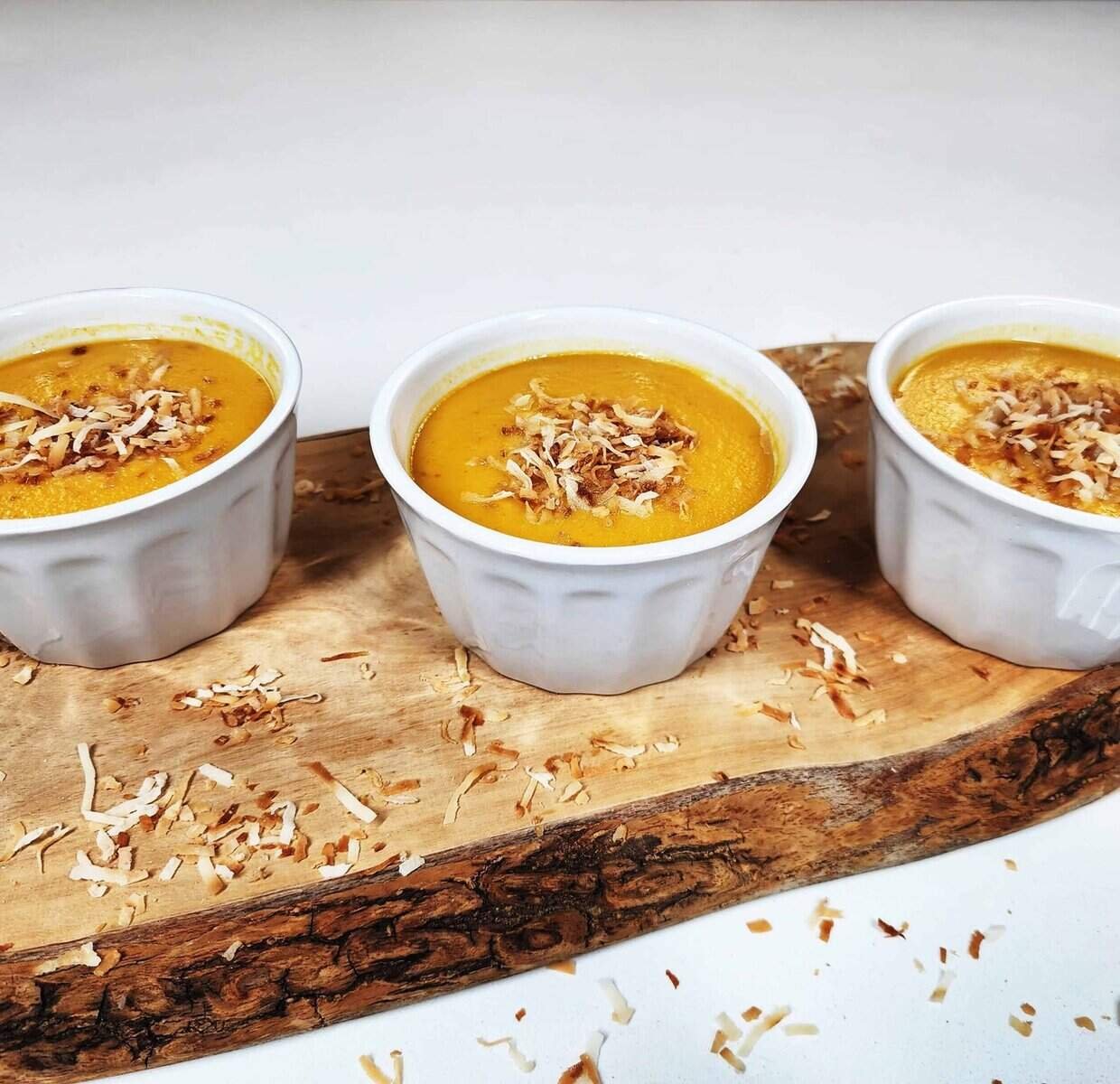
Thai pumpkin custard, Sangkhaya Fak Thong (สังขยาฟักทอง), is a coconut and pumpkin custard steamed until smooth and set, then served in the vessel it was made in. This version uses canned pumpkin, eggs, and coconut milk poured into ramekins and steamed. Sweet, fragrant, golden. At the street market it came in yellow squares. At home it comes in a ramekin.
Note From Susie

Sawasdee Kha, and Hello.
My mother rarely made this at home. That is what made it a treat.
We would go to the street market, busy, loud, everything happening at once, and after lunch she would take me to get it. I was young. The market was the kind of place where you stayed close to the person you came with. And then there it was, yellow squares, set out at the stall, the smell sweet and fragrant in the middle of all that noise.
That smell. Sweet coconut and something warm and slightly floral, pandan, though I did not know the word for it then. It found you the way good things at markets always do, before you were looking for it.
She did not make it often at home because it took time and patience and a steamer and a whole pumpkin and a particular kind of attention that a busy day did not always allow. So it remained the market thing. The after-lunch thing. The treat that was a treat because it did not appear every day.
I make it at home now in ramekins, canned pumpkin, eggs, coconut milk, poured and steamed. Simpler than the whole pumpkin. The same fragrance, the same smooth golden custard, the same taste. When it comes out of the steamer and I run a spoon through the surface, smooth, set, golden, I am back at that stall. The market busy around me. Her hand somewhere nearby.

What’s In This Page
“That smell found you before you were looking for it.”
— Her Hands His EyesWhat Is Thai Pumpkin Custard?
Thai pumpkin custard, สังขยาฟักทอง, Sangkhaya Fak Thong, is one of the most beloved Thai desserts, found at street markets, temple fairs, and home kitchens across Thailand. Traditionally it is a coconut custard steamed inside a whole pumpkin or kabocha squash, then served at room temperature. The version made here uses canned pumpkin stirred into the custard base, eggs, coconut milk, and palm sugar, and steamed in individual ramekins. The result is the same fragrant, smooth, golden custard, made practical for a home kitchen without a whole pumpkin and a steamer large enough to hold it.
What makes a Thai pumpkin custard recipe distinct from Western custard is the coconut milk in place of dairy cream, the palm sugar in place of white sugar, and the vanilla extract that gives the custard its warm, fragrant quality. The canned pumpkin adds earthiness and color. The finished custard is deeply golden, smooth, and set firm enough to hold a spoon’s impression on the surface.
At street markets across Thailand, the traditional whole-pumpkin version is sold sliced, yellow squares, the custard inside the dark green skin. The ramekin version carries the same flavor, the same fragrance, the same golden color. According to the Oxford Companion to Food, coconut-based custards and steamed desserts are found throughout Southeast Asian culinary tradition, with fragrant preparations particularly common in Thailand, Malaysia, and Indonesia.
Yellow squares at a stall, the smell sweet before you arrived. A ramekin on the counter, the same smell finding you now.
What You’ll Need

Canned pumpkin purée, one cup, pure pumpkin, not pumpkin pie filling. The difference matters: pumpkin pie filling already contains sugar and spices that will pull the custard in the wrong direction. Pure pumpkin purée is the one ingredient. It adds earthiness and the deep golden color and integrates smoothly into the custard base without any additional preparation.
Coconut milk, one cup, full fat from a can. Shake it before opening so the fat and liquid are combined before measuring. Full fat coconut milk is what gives the custard its richness and smooth, yielding texture.
Palm sugar, half a cup, shaved or chopped fine so it dissolves completely. Palm sugar is rounder and less sharp than white sugar, with a faint caramel quality that deepens the custard. White sugar works as a substitute but produces a slightly flatter sweetness.
Eggs, three whole eggs. They set the custard. Whisked thoroughly in a separate bowl before combining with the pumpkin mixture.
Salt, a quarter teaspoon, for balance. Vanilla extract, half a teaspoon, for the warm fragrance that makes the kitchen smell the way the market stall did. Pandan extract or fresh pandan leaves steeped in the warm coconut milk are equally correct and will bring the more traditional floral fragrance. Any of the three works. Use what you have.
Six ramekins, standard size. A large steamer or wok with a steamer rack and lid. A fine mesh sieve for straining. A ladle for filling the ramekins cleanly.
VISUAL WALK THROUGH

Step 1. Prepare the custard mixture.
In a saucepan, combine the pumpkin purée, coconut milk, and palm sugar. Heat the mixture gently over medium-low heat, stirring occasionally, until the palm sugar fully dissolves. This infuses the coconut milk with the pumpkin’s natural sweetness, creating a flavorful base for the custard. Once dissolved, remove the saucepan from heat and allow the mixture to cool slightly.
Step 2. Whisk together the custard mixture.
While the pumpkin mixture cools, whisk the eggs thoroughly in a separate bowl. Add the salt and vanilla extract. Whisk until smooth and well combined. Slowly pour the cooled pumpkin mixture into the bowl of whisked eggs, stirring continuously to prevent the eggs from curdling. This gradual incorporation blends the creamy pumpkin-infused coconut milk with the eggs into a smooth, velvety custard base.


★ Step 3. Strain for smoothness and fill the ramekins. This is What Makes the Difference.
Strain the custard mixture through a fine sieve into a heatproof dish or individual ramekins. This removes any lumps or solid particles, ensuring the custard is impeccably smooth. Pour into the ramekins and cover each tightly with foil. The foil prevents condensation from the steamer lid from dripping onto the surface of the custard and creating pits or a wet top. This is the step most home cooks skip. The foil takes ten seconds per ramekin and is the difference between a smooth, even surface and one marked by water droplets.
Step 4. Steam gently for thirty to forty minutes until set.
Place the covered ramekins in a steamer over medium heat. Steam gently for approximately thirty to forty minutes, or until the custard is set with a slight jiggle in the center when gently shaken. The heat must be gentle, not a rolling boil. A gentle, steady simmer produces a smooth custard. A skewer inserted in the center should come out clean when done.


Step 5. Cool and serve.
Once steamed, remove the custard from the heat and remove the foil immediately. Allow to cool to room temperature. Serve Sangkhaya Fak Thong chilled or at room temperature, allowing its flavors to meld and develop. Top with a little toasted coconut or a drizzle of coconut cream for an extra treat.

Sang Kaya Fak Thong สังขยาฟักทอง Thai Pumpkin Custard
Equipment
- Large steamer or wok with steamer rack and lid
- Small saucepan
- Fine mesh sieve
- Mixing bowl
- Whisk
- Individual ramekins or one 8-inch round baking dish
- Ladle
Ingredients
- 1 cup pumpkin puree canned or fresh
- 1 cup coconut milk
- 1/2 cup palm sugar
- 3 eggs
- 1/4 tsp salt
- 1/2 tsp vanilla extract or pandan extract
Instructions
- Prepare the Custard Mixture:In a saucepan, combine the pumpkin puree, coconut milk, and palm sugar. Heat the mixture gently over medium-low heat, stirring occasionally, until the palm sugar fully dissolves. Once dissolved, remove the saucepan from heat and allow the mixture to cool slightly.
- Whisk Eggs:While the pumpkin mixture cools, take a separate bowl and whisk the eggs thoroughly.Whisk until smooth and well combined.
- Combine and Blend:Slowly pour the cooled pumpkin mixture into the bowl of whisked eggs, stirring continuously to prevent the eggs from curdling.
- Strain for Smoothness:strain the custard mixture through a fine sieve into a heatproof dish or individual ramekins.
- Steam to Perfection:Cover ramekins with foil, place the dishes in a steamer over medium heat. Steam gently for approximately 30-40 minutes or until the custard is set with a slight jiggle in the center.
- Cool and Serve:Once steamed, remove the custard from the heat , remove foil, and allow it to cool to room temperature. Serve Sang Kaya Fak Thong chilled or at room temperature, allowing its flavors to meld and develop. Top with a little toasted coconut or a drizzle of coconut cream for an extra treat.
Video

Notes
Nutrition
LET’S GET THIS RIGHT
Why is my Thai pumpkin custard grainy or bubbly on top?
The steam heat was too high. A rolling boil under the steamer creates violent steam that disturbs the custard as it sets, producing a grainy, pitted surface rather than a smooth one. Reduce the heat to a gentle, steady simmer before the ramekins go in and keep it there for the entire cooking time. The custard will still set correctly, it just needs steady, gentle heat rather than aggressive steam.
Why does my Thai pumpkin custard have white streaks through it?
The custard was not strained before filling the ramekins. Egg chalazae, the white fibrous cords attached to the yolk, set during steaming into visible white streaks. Always strain the mixture through a fine mesh strainer into a pouring vessel before filling the ramekins. It takes thirty seconds and is the single most impactful step for the custard’s appearance.
Why is the surface of my Thai pumpkin custard pitted and wet-looking?
The ramekins were not covered with foil before steaming. Condensation from the steamer lid drips onto the unprotected custard surface during cooking and creates pits and a wet, uneven appearance. Cover each ramekin tightly with foil before placing in the steamer. Remove the foil immediately after the ramekins come out.
How do I know when Thai pumpkin custard is done?
Press the surface of one ramekin gently. It should feel set at the edges and just barely yield at the very center. A skewer inserted in the center should come out clean with no liquid custard on it. At thirty minutes the custard in a standard ramekin should be nearly done. At forty minutes it should be fully set. Do not overcook. An overcooked custard will be rubbery rather than smooth and yielding.
Can I use pumpkin pie filling instead of canned pumpkin for this recipe?
Do not use pumpkin pie filling. It already contains added sugar and spices cinnamon, nutmeg, ginger that will pull the custard toward a Western pie flavor rather than Thai pumpkin custard. Use pure pumpkin purée only. The label should say one ingredient: pumpkin.
FLAVOR PROFILE
The smell arrives before you see it. Sweet and warm, the vanilla finding you first, fragrant and slightly floral. Then the coconut underneath it, rich and warm from the full-fat milk. Then the pumpkin, earthy and faintly sweet, giving the custard a depth that plain coconut custard does not have.
The color is golden, deeply and specifically golden from the egg yolks and the canned pumpkin together. In a ramekin it arrives smooth, the surface unmarked, the color even from edge to edge. A child at a market remembers yellow squares. This is the same yellow, in a different shape.
On the tongue the custard is smooth and dense, not as light as a creme brulee, not as firm as a terrine. Something in between, with a richness that gives way cleanly under the spoon and a fragrance that stays on the palate after the bite.
It is not a loud dessert. It does not announce itself. It is the sweet thing at the end of an ordinary afternoon, in the middle of a busy market, that stayed. My mother found it before I did. She brought it to me. I have been finding it ever since.
SUSIE’S KITCHEN NOTES
The ramekin version of Thai pumpkin custard is more forgiving than the whole-pumpkin version in almost every way except one: the steam heat. Because the custard is in a small open vessel rather than inside a dense pumpkin that insulates it from direct heat, it responds immediately to changes in steam intensity. Too high and it bubbles. Too low and it takes much longer to set. The sweet spot is a steady, gentle simmer, the kind where steam rises consistently but there is no sound of aggressive boiling. Once you find that heat level, keep it there.
The canned pumpkin should be pure purée, smooth, with no added liquid, no chunks, no spices. Open the can and check the consistency before using. Some brands are wetter than others. If the purée looks very loose, spoon it into a fine mesh strainer set over a bowl and let it drain for ten to fifteen minutes before using. Too much water in the purée will thin the custard and affect how firmly it sets.
The vanilla extract in this recipe is doing the fragrance work. Half a teaspoon. Smell the custard mixture before it goes into the ramekins. The fragrance should be present and warm, not sharp or artificial. If it smells right before steaming, it will smell right when you open the refrigerator the next morning.
The custard can be made one day ahead. It is better that way. The flavors settle overnight and the texture firms further in the refrigerator. Make it the evening before you need it, cool to room temperature, cover the ramekins with plastic wrap, and refrigerate. The next day the custard is exactly what it should be. The smell when you uncover it is the market smell, arriving in your own kitchen. That is the whole point of making this at home.
PAIRING SUGGESTIONS
Thai pumpkin custard is the end of the meal, the sweet thing that closes the table after everything else has been eaten. The meals it belongs after are the ones built from the dishes on this site: the chicken larb that comes together fast and bright, the Thai cashew chicken that filled the family kitchen with its sweet savory smell, the Thai omelet that started simple and grew. After any of them, the custard arrives in its ramekin quietly and finishes it. For a full Thai dessert table, the Mango sticky rice belongs alongside, one smooth and golden in its ramekin, both of them sweet and coconut-forward. A cup of Thai iced tea alongside the custard is the pairing that closes it completely, sweet and cold against the cool fragrant custard, the way the afternoon at the market closed with something sweet and something to drink. My mother found this at the market. I find it in my own kitchen now.
FAQ
What is Thai pumpkin custard (Sangkhaya Fak Thong)?
Thai pumpkin custard, Sangkhaya Fak Thong (สังขยาฟักทอง), is a Thai dessert made from eggs, coconut milk, canned pumpkin purée, and palm sugar, steamed until set and smooth. Traditional versions are steamed inside a whole kabocha squash. This home version uses canned pumpkin purée poured into ramekins and steamed, producing the same fragrant, golden custard made practical for a home kitchen. Vanilla extract gives it its warm, distinctive fragrance. It is served chilled or at room temperature.
How do you make Thai pumpkin custard in ramekins?
Combine pumpkin purée, coconut milk, and palm sugar in a saucepan over medium-low heat until the sugar dissolves, then cool. Whisk eggs with salt and vanilla extract until smooth, then slowly pour in the cooled pumpkin mixture, stirring continuously. Strain through a fine mesh sieve into a pouring vessel. Pour into ramekins, cover each tightly with foil, and steam gently for thirty to forty minutes until set. Remove foil immediately, cool to room temperature, then refrigerate at least one hour before serving.
Can I use canned pumpkin for Thai pumpkin custard?
Yes. Pure canned pumpkin purée works well and makes the recipe practical for a home kitchen. Use pure pumpkin purée only, not pumpkin pie filling, which contains added sugar and spices that will alter the flavor. The canned pumpkin adds the golden color and earthy pumpkin flavor to the custard. If the purée looks very wet, drain it briefly through a fine mesh strainer before using.
Why is vanilla extract used in this Thai pumpkin custard recipe instead of pandan?
Traditional Thai pumpkin custard uses pandan for its floral fragrance. This version uses vanilla extract for convenience and accessibility. It gives the custard a warm, fragrant quality that complements the coconut milk and pumpkin beautifully. Vanilla extract is available at any grocery store and produces a fragrant, satisfying custard without requiring a trip to a specialty Asian market. If you have access to pandan extract, you can substitute it in equal measure.
How long does Thai pumpkin custard take to make in ramekins?
Active preparation takes about fifteen minutes. Steaming takes thirty to forty minutes. Cooling before serving takes at least one hour in the refrigerator, ideally overnight. Total time from start to table is approximately two hours, most of which is hands-off. The custard can be made a full day ahead and improves overnight as the flavors settle and the texture firms in the refrigerator.
Is Thai pumpkin custard served hot or cold?
Thai pumpkin custard is served chilled or at room temperature, never hot. It must cool completely after steaming before it is served. Chilled from the refrigerator is the best version: the custard is firmer, the flavors are deeper, and the surface holds cleanly under a spoon. The ramekin version is served directly in the ramekin with a small spoon. It should never be served warm as the texture is wrong and the fragrance has not had time to develop fully.
How do you store Thai pumpkin custard?
Cover the ramekins with plastic wrap and refrigerate for up to three days. The fragrance is strongest on the first day and fades slightly by day three, but the custard remains good throughout. Thai pumpkin custard does not freeze well. The texture changes on thawing and will not return to its original smoothness. Make it fresh and eat it within three days.