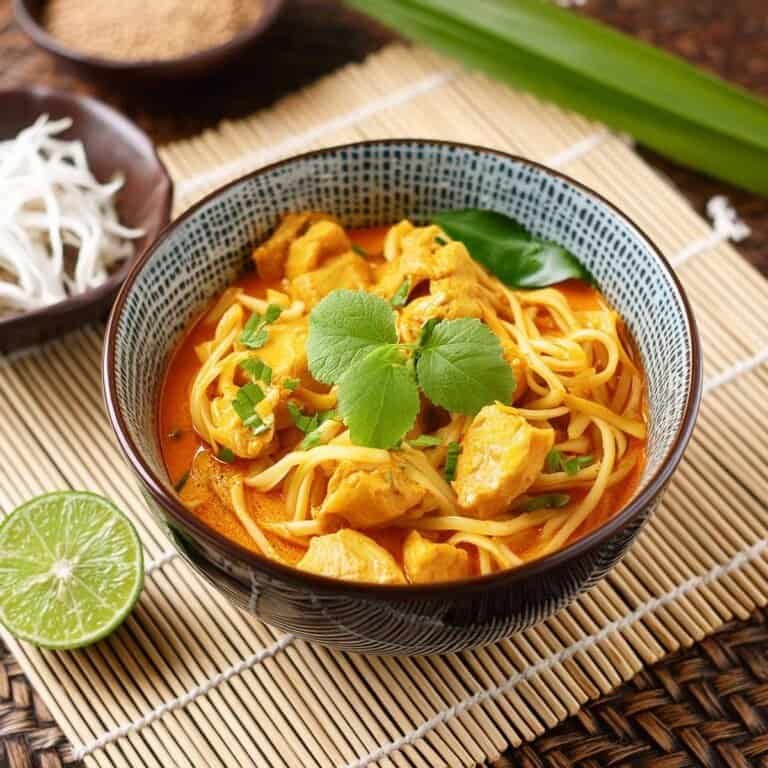
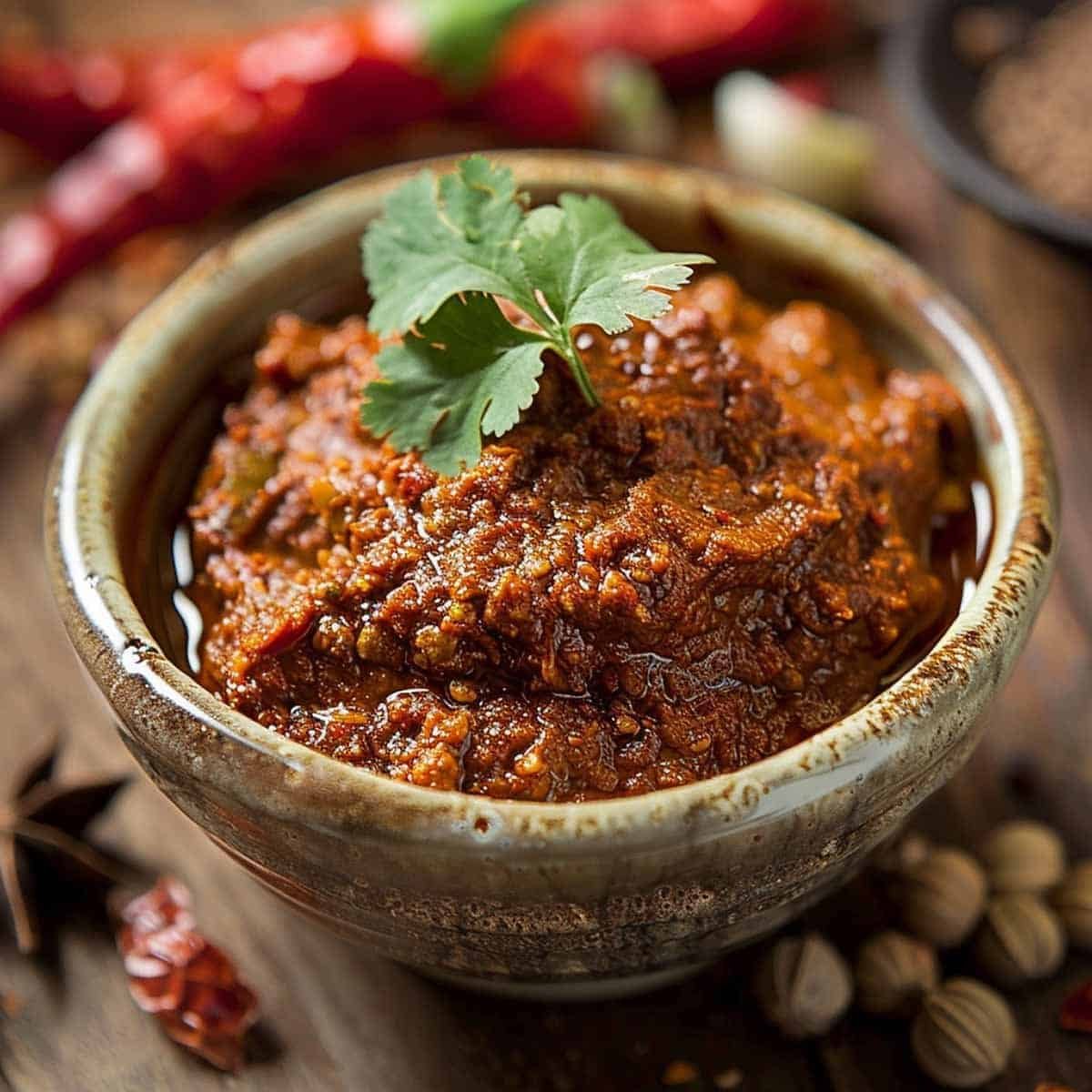
What Is Massaman Curry Paste?
Massaman curry paste (แกงมัสมั่น) is the richest, most complex of the Thai curry pastes, built on dried red chilies, lemongrass, galangal, and shallots alongside warm whole spices, cardamom, cinnamon, cloves, cumin, and coriander, that reflect centuries of Persian and Malay culinary influence. It is slower and deeper than red or green curry paste. The smell of the spices toasting is where it begins.
Note From Susie

Sawasdee Kha, and Hello.
The smell of all the spices together. That is the first memory. That is always the first memory with Massaman.
My mother and her sisters made this at our home in Thailand when I was still young, and the smell of it was something I understood before I understood the dish itself. Cardamom and cinnamon and cloves and cumin, all of them toasting together before anything else happened, before the mortar was even reached for. A small child in that kitchen did not need to know what each spice was called to know that something warm and deep and worth paying attention to was being made.
My mother tamed the spice level for me, turning the heat down so the flavors could find me properly without the chili overwhelm that would have pushed a young palate away. I learned to love this fairly early because she made it easy to love early. That is the kind of cook she was.
And then it followed us to Maryland. The same paste, the same spices, the same smell filling a completely different kitchen in a completely different country. That is the thing about Massaman. It carries. The spices travel. The smell arrives in whatever room the paste is being made in and it is the same smell it has always been, regardless of where the kitchen is.
I still smell it the moment the spices go into the dry pan. Thailand and Maryland both, in the same moment.

What’s In This Page
“The spices travel.”
— Her Hands His EyesWhat Is Massaman Curry Paste?
Massaman curry paste (แกงมัสมั่น) is the most complex and the most historically layered of the Thai curry pastes. Where red curry paste is built on dried red chilies and fresh aromatics, and green curry paste on fresh green chilies and herbs, Massaman paste is built on both: dried chilies, lemongrass, galangal, kaffir lime zest, shallots, and garlic, combined with a suite of warm whole spices that are found nowhere else in Thai curry making: cardamom, cinnamon, cloves, cumin, coriander seed, and mace. These spices are what give Massaman its warmth, its depth, and its particular character, the flavor profile that is simultaneously Thai and something older and farther-reaching.
The name Massaman is derived from the Arabic Muslim. The curry has its roots in the Persian and Malay Muslim traders who traveled through Thailand centuries ago, bringing their spice traditions with them. The result is a curry paste that reflects the meeting point of Thai aromatic cooking and Middle Eastern spice culture, with lemongrass and galangal alongside cardamom and cinnamon, fish sauce and shrimp paste alongside the warm whole spices. According to the Oxford Companion to Food, Massaman curry is one of the most internationally recognized Thai dishes, described by food writers as among the most complex curries in the world.
The whole spices are toasted before the mortar. The smell of them toasting is where Massaman begins. It is a warm smell, deeper and more layered than any other Thai curry paste being made, and it fills the kitchen before any of the other ingredients have been reached for.
The spices travel. They always have.
What You’ll Need
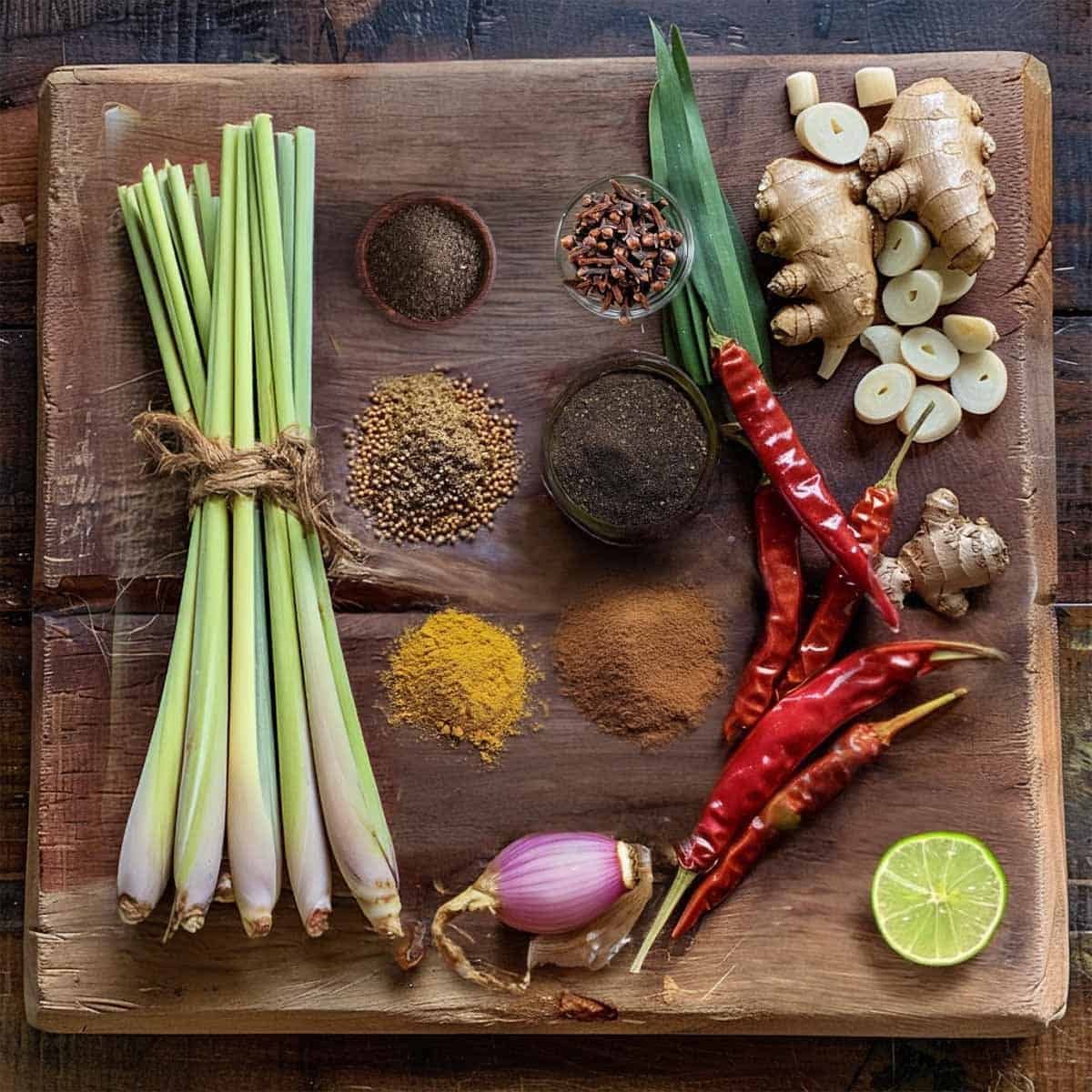
Dried red chilies, eight to ten, soaked in warm water for fifteen minutes until softened. These provide the heat and the color. Remove the seeds before soaking for a milder paste. Keep the seeds in for full heat. Massaman is the mildest of the main Thai curry pastes, but it should not be without heat. Start with six chilies and taste before adding more.
Lemongrass: two stalks, lower white portion only, sliced thin. Galangal: three to four thin slices. Kaffir lime zest: the zest of one kaffir lime, or two tablespoons of kaffir lime leaves very finely shredded if the fruit is not available. Shallots: three, roughly chopped. Garlic: four cloves. These are the Thai aromatics that form the base of the paste alongside the spices.
The whole spices are what make Massaman paste Massaman paste: cardamom pods, four, seeds only, pod discarded; cinnamon, one stick broken into pieces; cloves, four whole; cumin seed, one teaspoon; coriander seed, one tablespoon; nutmeg. All of these go into a dry pan together and are toasted over medium heat until fragrant, two to three minutes, stirring constantly. Then they are ground in the mortar or a spice grinder before joining the other ingredients. The toasting is not optional. Untoasted whole spices in a curry paste produce a flat, raw quality that no amount of cooking out can correct.
Fish sauce: one tablespoon, added after the paste is ground. Salt: a pinch.
A mortar and pestle. The paste should be smooth, smoother than Nam Phrik Pao, smoother than Nam Phrik Num. Massaman paste is fully integrated, the spices ground completely into the aromatics, the finished paste uniform in color and texture. A food processor can be used with a small amount of water to help it move, producing a smoother result than most home mortars can achieve for this quantity of ingredients. Either method is correct.
VISUAL WALK THROUGH
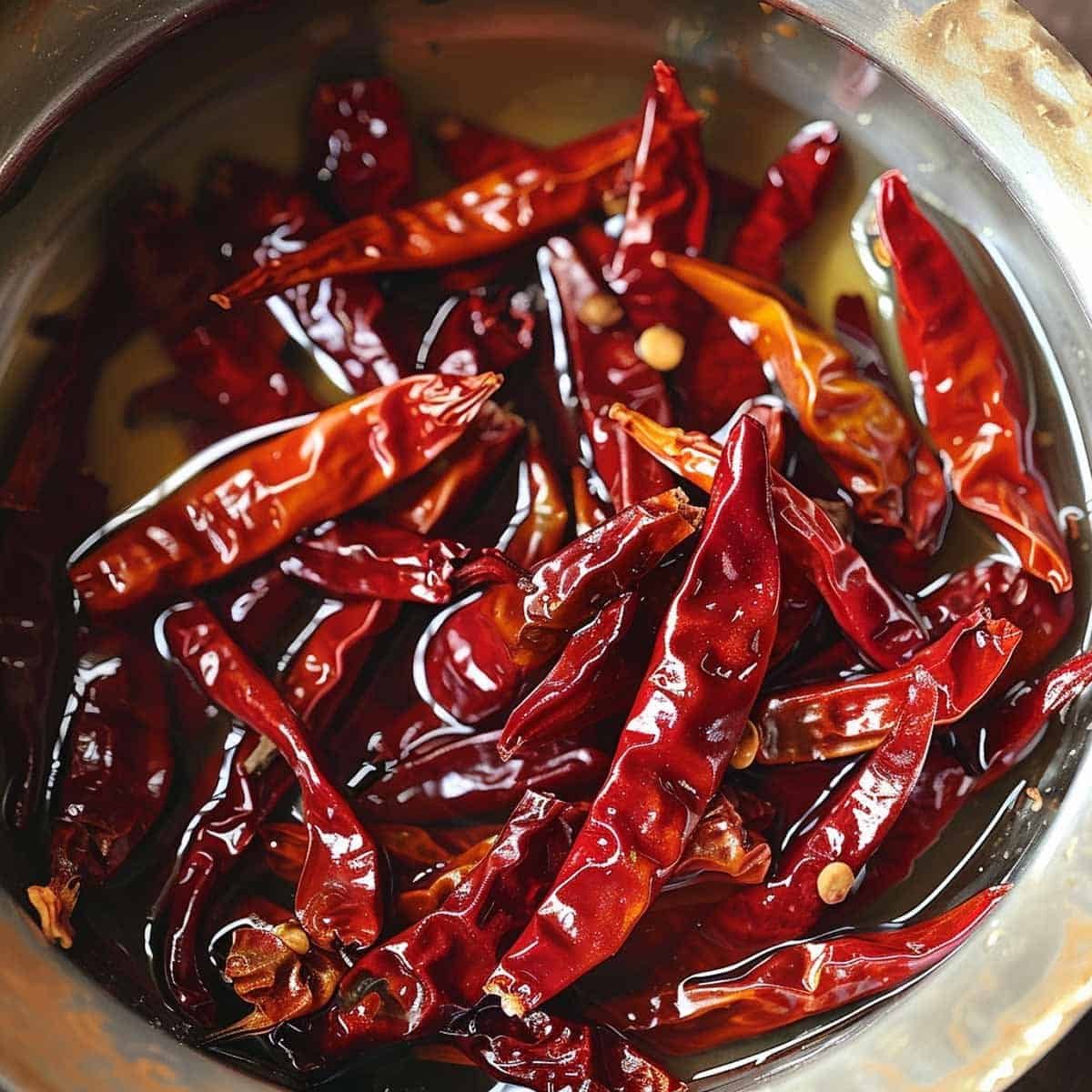
Step 1. Soak the chilies and prepare the ingredients.
Begin by soaking the dried red chilies in hot water for about ten minutes to soften them. While the chilies are soaking, chop the shallots, garlic, galangal, and lemongrass. Grate the zest from a kaffir lime. Having everything prepared before blending ensures the paste comes together smoothly without interruption. Toast the whole spices before anything else happens.
Step 2. Blend the aromatics and spices.
Drain the chilies and place them in a blender or food processor. Add the chopped shallots, garlic, galangal, lemongrass, and kaffir lime zest. Add the ground coriander, cumin, cinnamon, nutmeg, cloves, cardamom, black pepper, and salt. Blend the ingredients together until they begin to form a paste. You may need to add a little water to help the ingredients move and blend evenly.
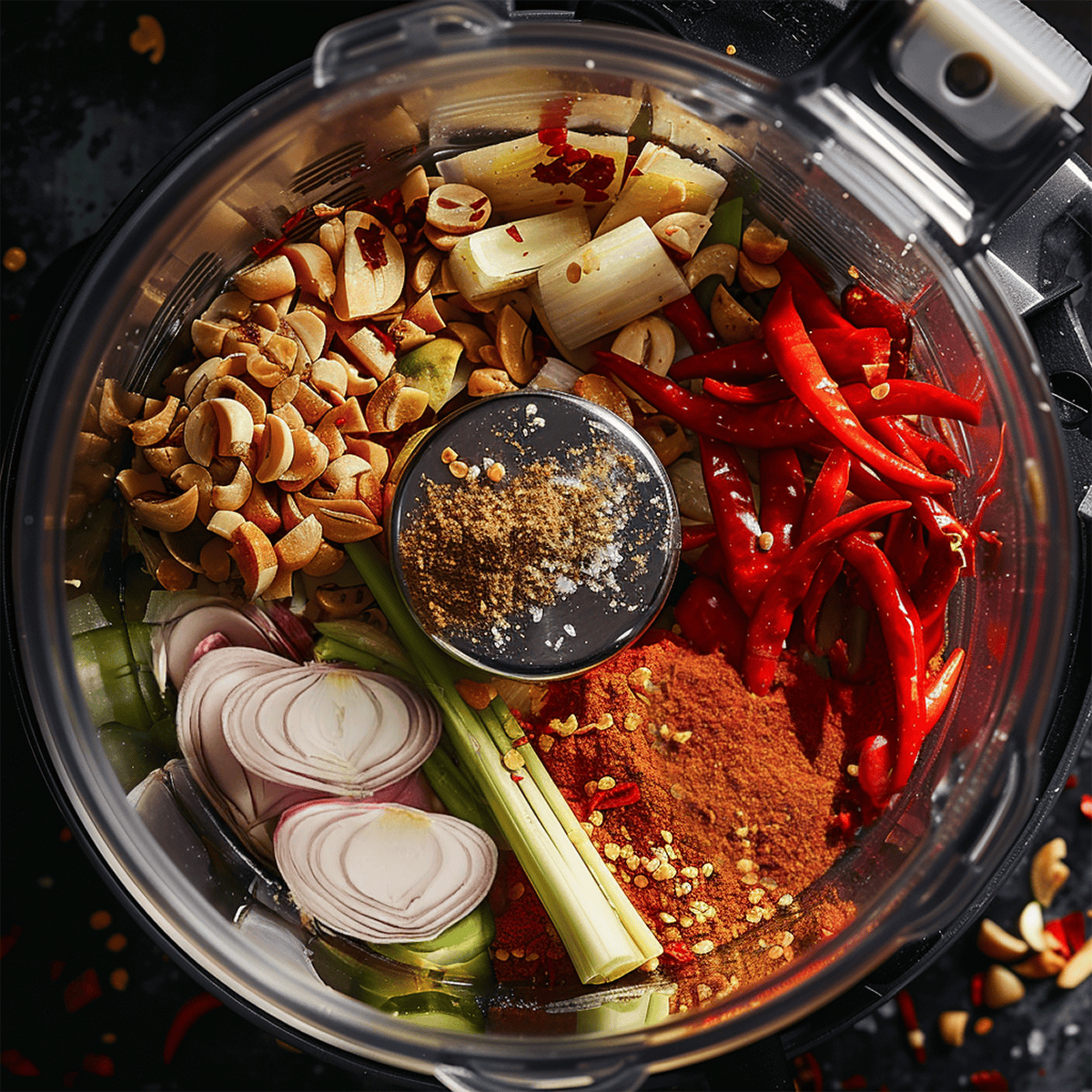
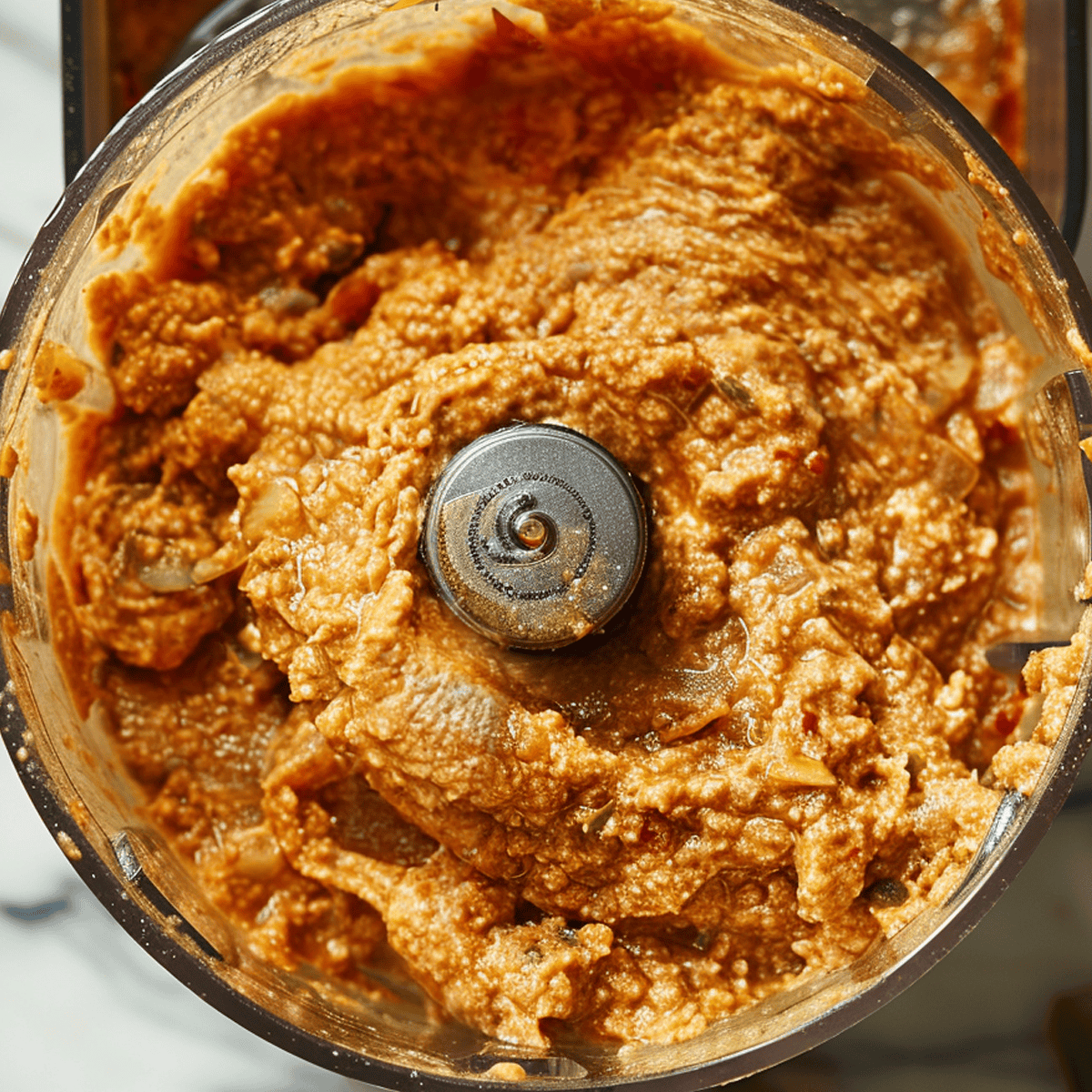
★ Step 3. Add the final ingredients and blend until completely smooth. This is What Makes the Difference.
Once the ingredients are mostly smooth, add the roasted peanuts if using, fish sauce, and tamarind paste. Continue to blend until the paste is completely smooth. This is the step that unifies all the components. The finished paste should be smooth, deep reddish-brown, and uniformly fragrant. The warmth of the spices should be present and layered, with cardamom and cinnamon identifiable, the heat of the chili behind them.
Step 4. Store or use immediately.
Transfer the curry paste to a jar and store in the refrigerator for up to two weeks, or use immediately in your favorite Massaman curry recipe. The paste improves slightly over the first day as the flavors settle together. A paste made today and used tomorrow will be more cohesive than one used immediately. Make a full batch. The work is the same whether you are making paste for one curry or four.
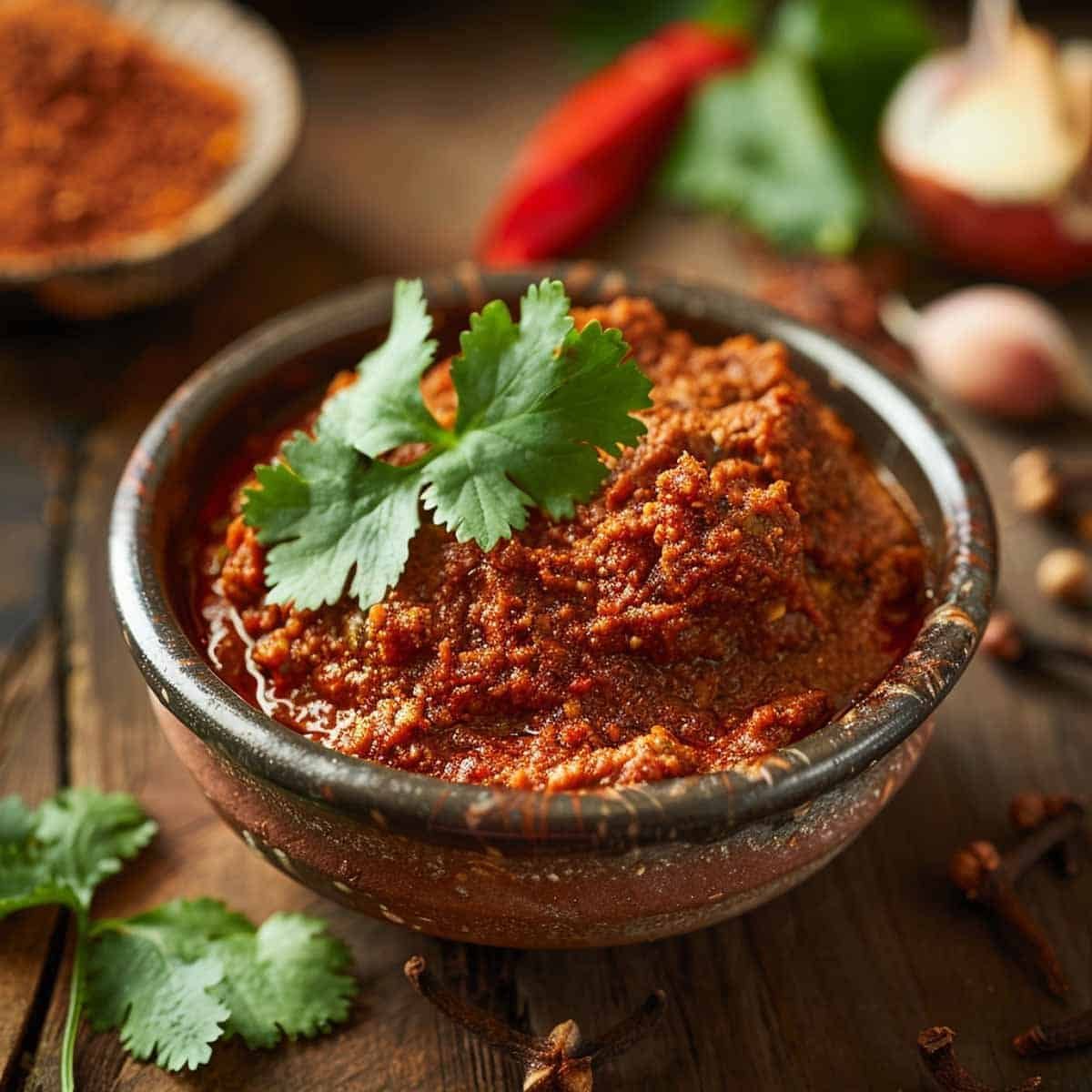
Massaman Curry Paste
Ingredients
- 4 dried red chilies seeded and chopped
- 1/4 cup chopped shallots
- 2 tablespoons chopped garlic
- 1 tablespoon chopped galangal
- 2 teaspoons chopped lemongrass tender part only
- 1 teaspoon grated kaffir lime zest
- 1 teaspoon ground coriander
- 1 teaspoon ground cumin
- 1/2 teaspoon ground cinnamon
- 1/4 teaspoon ground nutmeg
- 1/4 teaspoon ground cloves
- 1/4 teaspoon ground cardamom
- 1/4 teaspoon ground black pepper
- 1/4 teaspoon salt
- 2 tablespoons roasted peanuts optional, for a thicker, nuttier flavor
- 1 tablespoon fish sauce
- 1 tablespoon tamarind paste
Instructions
- Soak the Chilies: Begin by soaking the dried red chilies in hot water for about 10 minutes to soften them.
- Prepare the Ingredients: While the chilies are soaking, chop the shallots, garlic, galangal, and lemongrass. Grate the zest from a kaffir lime.
- Toast the Spices Put the cardamom seeds, cinnamon, cloves, cumin seed, and coriander seed in a dry pan over medium heat, stirring constantly, for two to three minutes until fragrant. Remove from heat, cool completely, then grind to a powder.
- Blend the Ingredients: Drain the chilies and place them in a blender or food processor. Add the chopped shallots, garlic, galangal, lemongrass, and kaffir lime zest. Also add the ground coriander, cumin, cinnamon, nutmeg, cloves, cardamom, black pepper, and salt.
- Grind to a Paste: Blend the ingredients together until they form a paste. Depending on the power of your blender, you may need to add a little water to help the ingredients move and blend evenly.
- Add Final Ingredients: Once the ingredients are mostly smooth, add the roasted peanuts (if using), fish sauce, and tamarind paste. Continue to blend until the paste is completely smooth.
- Store or Use:Transfer the curry paste to a jar and store it in the refrigerator for up to two weeks, or use immediately in your favorite Massaman curry recipe.
Notes
Nutrition
LET’S GET THIS RIGHT
Why does my Massaman curry paste taste flat despite using all the ingredients?
The whole spices were not toasted, or were not toasted long enough. Untoasted cardamom, cinnamon, cloves, cumin, and coriander in a curry paste produce a raw, flat spice flavor rather than the warm, layered depth that Massaman is built on. Toast until fragrant, until the kitchen smells of warm spice, and let cool completely before grinding. This step cannot be skipped or shortened.
Why is my Massaman paste grainy instead of smooth?
The fibrous ingredients, lemongrass and galangal, were not broken down enough before the other ingredients were added. These require five to eight minutes of sustained pounding in the mortar before they will integrate properly. Adding chilies or shallots before the lemongrass is fully broken down will produce a paste with fibrous threads throughout that further pounding cannot correct. Do the slow step completely before moving on.
Can I use pre-ground spices instead of whole spices for Massaman paste?
You can, but the result will be less complex and less fragrant. Pre-ground spices lose their essential oils over time and do not develop the same depth during toasting that whole spices do. If using pre-ground spices, reduce the quantity by half, as ground spices are more concentrated than whole, and still toast them briefly in the dry pan before adding to the paste. Whole spices are strongly preferred for Massaman paste.
What is the difference between Massaman curry paste and red curry paste?
Massaman curry paste contains all the ingredients of red curry paste: dried red chilies, lemongrass, galangal, shallots, garlic, shrimp paste, plus a suite of warm whole spices: cardamom, cinnamon, cloves, cumin, and coriander. These spices are not present in standard red curry paste and are what give Massaman its distinctive warmth and depth. Massaman is generally milder in chili heat than red curry paste and significantly more complex in its overall flavor profile.
How much Massaman curry paste do I use per serving?
Two to three tablespoons of homemade paste per serving of curry is the starting point. Homemade Massaman paste is more concentrated and more aromatic than store-bought. Start with two tablespoons, fry it in the coconut cream, taste the broth, and add more if needed. The paste goes into the pan first, fried in the thick coconut cream before any liquid is added, which is the same method as every other Thai curry on this site.
FLAVOR PROFILE
The smell arrives before the paste is ever finished, with the whole spices in the dry pan releasing their oils as the heat works through them. Cardamom first, floral and slightly citrus. Then the cinnamon, warm and sweet. Then the cloves, sharper and more immediate. Then the cumin and coriander underneath all of it, earthy and roasted. All of them together producing something that is warmer and more layered than any other Thai curry paste being made.
In the mortar, as the aromatics join the ground spices, the smell deepens, with the lemongrass and galangal adding their sharpness to the warmth of the spices, the chilies bringing color and a slow building heat, the shrimp paste underneath everything adding the fermented depth that holds the whole paste together.
On the tongue, before it ever becomes a curry, the paste is complex and warm and slightly sharp. The cardamom is identifiable. The cinnamon is present. The chili heat is building from behind the spice warmth. The lemongrass is there at the edges, bright and specific. Every component is doing something and nothing is hiding.
In the finished curry, with coconut milk and beef or chicken and potatoes and roasted peanuts, the paste becomes something softer and richer, the spice warmth deepening further over the long slow simmer, the coconut milk rounding everything. It is the curry that takes the longest and produces the most.
My mother tamed the heat so the warmth could be found first. The warmth was always the point.
SUSIE’S KITCHEN NOTES
The cardamom pods should be opened and only the seeds used, as the green or black pod itself is too fibrous and too intensely flavored to go into the paste. Press the pods with the flat of a knife to split them open and extract the small dark seeds inside. These seeds are what carries the cardamom flavor. The pod goes in the discard pile.
Mace, the lacy outer covering of the nutmeg, adds a warm, slightly sweet, nutty quality that is distinct from both nutmeg and cinnamon. It is available at spice shops and online, sometimes as whole blades and sometimes pre-ground. A small amount goes a long way. If mace is genuinely unavailable, a pinch of freshly grated nutmeg is the closest substitute. The paste will still be correct without it but mace, when you can find it, is worth including.
My mother made Massaman paste in a mortar that was heavy and deep and had been used for years before I was born. A heavy granite mortar is the right tool. It does not tip during the sustained pounding that lemongrass and galangal require, and the weight of the pestle does work that a lighter mortar cannot. If you are making Thai curry pastes regularly, a heavy granite mortar is worth owning. The investment pays back every time you use it.
The spices in Massaman paste are what carried it from Thailand to Maryland. The same cardamom, the same cinnamon, the same cloves, all available in Maryland as they were in Thailand, the paste reproducible in any kitchen where the spices could be found. My mother understood this. She did not mourn what the new kitchen did not have. She found the spices and she made the paste and the curry smelled the same in Maryland as it had in Thailand. That is what spices do. They carry.
PAIRING SUGGESTIONS
Massaman curry paste is the beginning of Massaman curry, the long-simmered, coconut milk-based curry with beef or chicken, potatoes, roasted peanuts, and pearl onions that is one of the most beloved Thai dishes in the world. The paste fried in coconut cream, the remaining coconut milk added, the protein simmered for an hour or more until tender, the potatoes and peanuts absorbing the spiced broth. Steamed jasmine rice alongside, always. For a table where the Massaman curry is one of several dishes, the Stir fried morning glory brings its bright, fast green vegetable dish alongside the slow, rich curry, the contrast between them making both more satisfying. The Thai iced tea is the drink alongside, its sweetness and cold temperature cutting through the richness of the Massaman in a way that makes both better. And for those who want to understand the paste that precedes this one in complexity, the Thai yellow curry paste shows how warm spices work in a simpler context before Massaman adds everything else. My mother made this paste in Thailand and in Maryland. The spices were available in both places. The curry smelled the same. That is still the whole point.
FAQ
What is Massaman curry paste?
Massaman curry paste (แกงมัสมั่น) is the most complex of the Thai curry pastes, built on dried red chilies, lemongrass, galangal, shallots, garlic, and shrimp paste combined with warm whole spices, cardamom, cinnamon, cloves, cumin, and coriander, that reflect centuries of Persian and Malay culinary influence in Thai cooking. It is toasted, ground, and pounded into a smooth, deeply flavored paste used as the base of Massaman curry. The spices are what make it distinct from all other Thai curry pastes.
How do you make Massaman curry paste from scratch?
Toast whole spices, cardamom seeds, cinnamon, cloves, cumin and coriander seed, in a dry pan until fragrant, then cool and grind. Soak dried red chilies in warm water for 15 minutes, then drain. In a mortar, pound lemongrass and galangal first until fully broken down, then add shallots, garlic, soaked chilies, kaffir lime zest, and shrimp paste, working each ingredient in fully before adding the next. Add the ground toasted spices last. Season with fish sauce. Use immediately or store.
What spices are in Massaman curry paste?
Massaman curry paste contains cardamom, cinnamon, cloves, cumin seed, coriander seed, and mace, warm whole spices that are toasted before being ground and added to the paste. These spices are not present in other Thai curry pastes and are what give Massaman its distinctive warmth and complexity. They reflect the Persian and Malay Muslim culinary influence that shaped Massaman curry over centuries of trade through Thailand.
What is the difference between Massaman curry paste and other Thai curry pastes?
Massaman curry paste contains warm whole spices, cardamom, cinnamon, cloves, cumin and coriander, that are absent from red, green, and yellow Thai curry pastes. It is generally milder in chili heat than red or green paste and more complex in its overall flavor. The warm spice profile reflects Persian and Malay culinary influence rather than the purely Southeast Asian aromatics of other Thai curry pastes. Massaman is the richest, most layered, and slowest-cooking of the main Thai curries.
How long does homemade Massaman curry paste keep?
Homemade Massaman curry paste keeps in an airtight container in the refrigerator for up to two weeks. It freezes well for up to three months. Press it into tablespoon portions in an ice cube tray, freeze, then transfer to a freezer bag. Each cube is approximately one tablespoon. The paste improves slightly over the first day as the spice flavors settle together. Make a full batch, as the mortar work is the same for a small amount as for a large one.
Can I use store-bought Massaman curry paste instead of homemade?
Yes. Maesri and Mae Ploy both produce reliable store-bought Massaman paste. Store-bought paste is a workable substitute when time does not allow for making it from scratch. Homemade Massaman paste is significantly more complex and fragrant, as the freshly toasted whole spices produce a depth that jarred paste approximates but cannot replicate. If you can make it from scratch, do. If you cannot, store-bought is better than omitting the paste entirely.
What do I make with Massaman curry paste?
Massaman curry paste is the base of Massaman curry, one of Thailand’s most beloved dishes, made with beef or chicken simmered in coconut milk with potatoes, roasted peanuts, and pearl onions over a long, slow cook. The paste is fried in thick coconut cream first, the remaining coconut milk added, then the protein and vegetables. The long simmer allows the spices to fully develop in the coconut milk. Massaman curry is served over jasmine rice and is one of the richest, most complex Thai curries.
NEWSLETTER SIGN-UP